





Pipedrive Review 2023: Features, Pros & Cons, And Alternatives
The Pipedrive CRM is one of the best customer relationship management and lead management software available for small businesses. When it comes to general features and ease of usage, the customer reviews on Pipedrive seem to be among the best. So, after looking at customer reviews and checking out the software system by ourselves, we have decided to review Pipedrive.
In this article, you will learn in general about Pipedrive, which is one of the best CRMs for small businesses. Furthermore, we will also discuss the pricing plans of Pipedrive, along with the features that it brings to the table. Next up, you will also find out whether this CRM software is a good option for your business or not. Finally, we have discussed some of the major pros and cons of Pipedrive. Hence, to learn more about this CRM software, read through to the end of the article.
Pipedrive CRM – A General Review Of The Software

Once you do a Pipedrive Login, you will feel that the CRM is simple and easy to use. There is no need for a learning curve before you start using the app.
According to PCMag.com,
“Pipedrive’s straightforward user interface (UI) is simple to pick up quickly, which is worth a lot compared to the time and expense some tools require for training and onboarding. Smaller SMBs and entrepreneurs charged with CRM tasks will welcome its ease of use.”
The primary function of the CRM is to make the sales pipeline more visual. However, you will need to customize the software beforehand based on the needs and demands of your business. The customization options are many, as you will be able to customize the API as well.
What Are The Pricing Plans Of Pipedrive?
As per the views in an article on Forbes.com,
“Standout features that Pipedrive offers include an intuitive layout designed for productivity, optional field completion so you can expedite new leads. The platform is fully customizable, so you can adapt it to your team’s unique processes. There is a 14-day free trial available for those who want to test it out, and no credit card is required.”
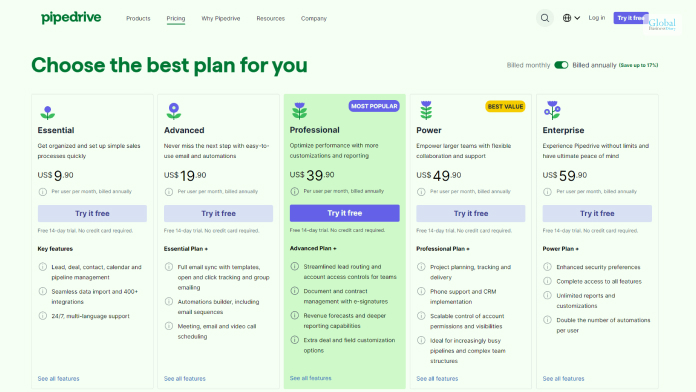
The following are the plans available on Pipedrive that you need to check out:
| Plans | Price |
|---|---|
| Essential | $9.90 per user per month (annual billing) |
| Advanced | $19.90 per user per month (annual billing) |
| Professional | $39.90 per user per month (annual billing) |
| Power | $49.90 per user per month (annual billing) |
| Enterprise | $59.90 per user per month (annual billing) |
What Are The Major Features Of Pipedrive?

One of the major aspects of Pipedrive is that, along with CRM tools, it comes with lead management options as well. The following are the major features that Pipedrive CRM offers you:
- The minimalistic interface helps you with ease of usage.
- There are plenty of customization options that allow you to use the platform based on your needs.
- You can also customize the chatbots, which you can place on the website, to capture new leads automatically.
- The number of automation features helps in ensuring no leads fall through the cracks.
- The software easily integrates with third-party software applications, as you can enhance your productivity.
Why Pipedrive Is A Good Software Option For Your Business?

As the name suggests, the focus of the software is the streamline the process of the sales pipeline. According to Forbers.com,
“Pipedrive is a cloud-based customer relationship management (CRM) tool designed by and for sales teams. The focus of this CRM is, as the name suggests, sales pipelines. Although there’s no free plan available, Pipedrive is affordable and easy to use, which is why it’s a solid choice for small businesses.”
The CRM guides your sales teams through the sales process. In addition to that, there are many options for you to record key contacts and offer feedback to teams as well. The CRM acts as a centralized platform for various sales and lead management processes.
There are many integration options available on Pipedrive as well. You can not only connect with the other software tools of Pipedrive but can also connect with other third-party software systems as well. This can help you to make the most of your productivity.
Furthermore, if you get problems with the software, the Pipedrive Support is also great, which can help you deal with complicacies on the software better.
The Major Pros And Cons Of Pipedrive
The following are some of the essential pros and cons of Pipedrive that you need to know before you make a purchase:
Pros Of Pipedrive
Here are the major pros of Pipedrive, which are sure to help your business:
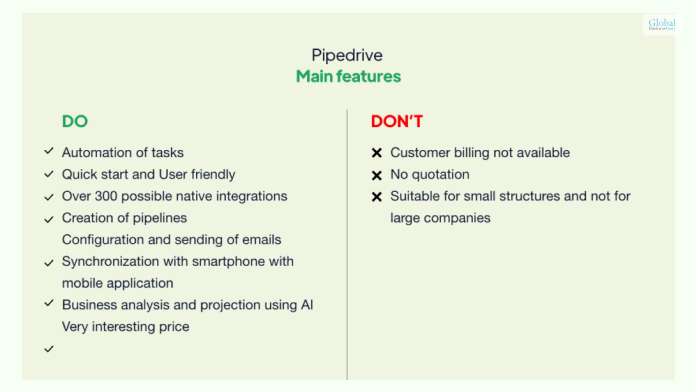
- The paid plans are quite affordable, and they start at only $9.90 per month.
- The sales pipeline on lead management is unlimited. Furthermore, there are many customization options as well.
- The sales assistant is powered by AI and machine learning. This one is available on all plans.
- To customize the software based on your business needs, you will have access to API as well.
- Most of the plans come with workflow automation. This helps you automate mundane jobs.
- Synchronization of calls and emails.
- For plans in the higher tier, contact info has the autofill feature as well.
- Most of the plans have built-in telephony features.
- The interface is extremely intuitive, and the workflow is based on the data.
- Comes with a mobile app for remote access.
Cons Of Pipedrive
The following are the cons that we have found with Pipedrive, and you need to be aware of them, too, before you buy a subscription:
- There are no free plans associated with Pipedrive.
- You cannot separate your contacts and new leads, which is important for lead management.
- The custom fields and reports on the software are limited in number on the lower-tier plans.
- You will get phone support only on the highest tier.
Summing Up
Hope this article was helpful for you in getting a better idea of the Pipedrive CRM software. If you are looking for software with a simple interface, high customization features, and enhanced automation functions, then Pipedrive is the best option for you. What are your reviews of the software system? Share your reviews of the same in the comments section below.
Read Also:
Tags:

Recent
Dinmukhamet Idrisov and a Gold-Mine Dispute From Kazakhstan’s Oligarchic Past
Oct 16, 2026

Memory Chips Are Becoming More Important in the AI Era
Aug 06, 2026

Why Enterprise Web Applications Still Choose Angular for Long-Term Growth
Aug 04, 2026

Due Diligence Decoded: Why Careful Evaluation Still Wins in Business
Jul 11, 2026

Related Articles

Zoho CRM – Best Features, Pricing, Pros, Cons, And Alternatives
Zoho CRM is a customer relationship management and lead management software that is popular among small businesses that are in their phase of growth. As clients and customer starts growing for a company, the Zoho CRM provides the extra features and quantity that the company needs. The free plan of Zoho also comes with numerous useful features. In this article, you will mainly learn about one of the popular CRM software systems, the Zoho CRM. Furthermore, we will discuss the plans available if you want to purchase the software. Furthermore, you will learn what are the major features that Zoho CRM has that your business can benefit from. Finally, we will discuss why this software system is a great option for your business, along with a few pros and cons regarding the same. Hence, to learn more about Zoho CRM, read on through to the end of the article. Zoho CRM – A General Overview Of The Platform A review article on Forbes.com puts it rightly – “Zoho CRM makes it easy for newcomers to get started with a CRM, especially if they’re not familiar with the software. The free plan includes just enough of the basic features to be helpful for an individual or an ultrasmall company. And the interface is intuitive and clean, which makes it even easier to learn to use.” This is one of the major factors that the Zoho CRM API is very popular among small businesses. Furthermore, the software system comes with a lot of features that are not only helpful for small businesses only, but for growing businesses as well. Zoho CRM Pricing In the following table, you will get the entire pricing and plans of the Zoho CRM: PlansMonthly PricingAnnual PricingZoho CRM FreeFreeFreeZoho CRM Standard$20 per user per month (annual billing)$14 per user per month (annual billing)Zoho CRM Professional$35 per user per month (annual billing)$23 per user per month (annual billing)Zoho CRM Enterprise$50 per user per month (annual billing)$40 per user per month (annual billing)Zoho CRM Ultimate$65 per user per month (annual billing)$52 per user per month (annual billing)Zoho CRM Plus$65 per user per month (annual billing)$52 per user per month (annual billing)Zoho One$105 per user per month (annual billing)$90 per user per month (annual billing) What Are The Major Zoho CRM Features? Once you do a Zoho CRM login, you will find the Zoho interface being very user-friendly. Once in the software, you will also come across a variety of customization features. You can also create personalized layouts, which you can save, clone, and share. With a many automation features, you can simplify your complicated tasks. Furthermore, Zoho also comes with an AI assistant. According to the official website of Zoho CRM Plus, “Zoho's AI assistant, Zia, guides your teams by predicting business trends, suggesting the best times to contact customers, identifying sentiments in emails and tickets, and providing intelligent business dashboards.” Another great feature of Zoho is that it can be integrated with all the different Zoho software systems. Furthermore, the Zoho CRM supports other systems too. Why Is Zoho CRM A Great Option For Your Business? Being one of the best software options for lead management, Zoho CRM helps in unifying your business and marketing processes. According to the official website of Zoho CRM, “Zoho CRM Plus unifies your sales, marketing, customer service, and every other customer-facing team on one platform so you can deliver exceptional customer experiences to every customer. Unify business data, customer engagements, ROI, and more—all while keeping your customer at the center of everything you do.” With this CRM, you will be able to provide your customers with the needed convenience of omnichannel engagement. With Zoho, you can engage with your customers at every level of the customer lifecycle. You can always have full access and full information about your customers through different channels, as you will get real-time notifications on the software system. Zoho CRM – The Major Pros And Cons The following are some of the essential pros and cons that you must be aware of before you make a purchase of Zoho CRM: Pros Of Zoho CRM Here are the major pros of Zoho CRM: Zoho CRM comes with a free plan but with limited features. The pricing plans are affordable and friendly for small businesses. All the pricing plans contain the automation feature. You can integrate the CRM with various other Zoho software systems as well as other software systems. The CRM is simple and easy to customize. There is a mobile app as well, which allows remote access. If you do not like the software, you will get the money back in 30 to 45 days. Cons Of Zoho CRM Here are the cons of Zoho CRM that will allow you to make a decision while purchasing: The AI features come only the top-tier plans. There are only a limited number of custom fields. There are no integrations available for free plans. Zoho CRM Alternatives We think that Zoho CRM can be an excellent choice for a small business. However, it is not the best option for large businesses. According to Forbes.com, “While Zoho CRM is an excellent entry-level CRM, it may not be the best choice for every business. You can find plenty of Zoho CRM alternatives that could fit your CRM strategy better.” The following are the six top alternatives of Zoho CRM that you will find easily: 1. ActiveCampaign 2. Monday.com 3. Less Annoying CRM 4. Salesforce Pardot 5. LeadSquared 6. Hatchbuck Summing Up If you are running a startup, then there cannot be any better CRM solutions available than Zoho CRM. Furthermore, you can surely choose the alternatives, as per your needs and likings. However, when it comes to a combination of features and pricing, Zoho CRM is the best option of all. What is your review of this software system? Share your reviews regarding Zoho CRM in the comments section below. Read Also: Is Startup Business Insurance Necessary For New Businesses? 5 Most Powerful Marketing Strategy That Will Change Your Business What Is Commercial Insurance? And Its Different Types – Let’s Discuss
Jul 06, 2023
Pardot – Best Features, Pricing, Pros, And Cons: Let’s Discuss
With the change in the way of marketing processes and techniques, businesses are moving towards marketing automation. Within the CRM space, marketing automation is one of the fastest-growing aspects. This is because automation of marketing helps businesses realize better ROI and faster growth. One of the best marketing automation software is Pardot. In this article, we will give you a general review of the Pardot software, which is a popular marketing automation software by Salesforce. We will also give you reasons why Pardot is great software for small businesses and startups. Finally, we will inform you about some of the major features of Pardot, as well as the major pros and cons of the software. Hence, to learn in detail about the software read on through to the end of the article. Salesforce Pardot – A General Review Of The Platform Pardot is currently known as Salesforce Marketing Cloud Account Engagement. For this, we will use the name Salesforce Marketing Automation software. The software is created to automate marketing processes and carry out lead management in a faster and better manner. According to the official website of Salesforce.com, “Marketing Cloud Account Engagement is a B2B marketing automation solution that aligns marketing activities with sales goals to sell more effectively and build long-term customer relationships. It gives marketers and salespeople all the information and tools needed to find and win more customers.” With this Salesforce Marketing Automation software, you will come across rich customer insights within a split-second. Hence, you will be in a better position to make your B2B connections better and shall be able to maintain better relationships with them. Furthermore, you will also be able to find more leads whom you can be able to convert better. Read More: Less Annoying CRM – Pricing, Features, Pros And Cons, And More Salesforce Pardot Pricing – Different Levels Of Pricing According to Salesforceben.com, “Pardot (Account Engagement) follows a per org billing model, sometimes referred to as a ‘bucket’ license. This means that by purchasing one license of Pardot, you can give as many users access as your organization requires.” However, the different editions saw an increase in price in 2018. The following are the four different price options for Salesforce Pardot: EditionPriceFeaturesGrowth (Standard)$1250- Basic edition- Access to only core marketing processes like automation, email marketing, and engagement studio.Plus (Pro)$2500- Access to almost all the Salesforce Pardot features related to account engagement and marketing automation. - Also, the most popular option.Advanced (Ultimate)$4000- Business units and other increased services.Premium$15000- Meant for large organizations with large databases- Large marketing teams can work on it- Higher record limit than Advanced Salesforce Pardot – Why It Is A Great Option For Small Businesses? According to PCMag.com “While it's not cheap, Salesforce Pardot sets its own standard across martech automation and email marketing, mainly because it combines an intuitive design with very deep features covering loads of integration options and AI-powered analytics.” The following are the major reasons why you can implement Salesforce Pardot in your business organization: You will be able to generate better leads by using many useful features. You will have a better idea of the activities of the audience. This will help you to convert them into leads faster. With better personal outreach options, you will be able to make stronger connections. You can tailor email campaigns in the software by audience segmentation. You will have great data to monitor the performances. Hence, you will get a lot of options to improve. The AI will also help in dealing better with customers and also predict customer engagement. The Major Features That Come With Salesforce Pardot The following are the major features that Salesforce Pardot brings to your organization: The email marketing option in Salesforce Pardot comes with a lot of features and an intuitive interface. It integrates amazingly with other Salesforce platforms and software systems. The landing pages and Pardot forms are built aesthetically, and there are many customization options. There are many search tracking and optimization options which help marketers to get ROI on SEO efforts that are campaign specific. The Journey Builder tool helps a lot in managing leads. There are other lead management tools as well. You will get a lot of access to analytics and data. There is also a Salesforce Pardot certification, which is given as a credential to those people with experience in working and implementing Pardot solutions. Basically, it is meant for people who use their knowledge in designing, building, and executing marketing processes in a Salesforce Pardot system. Essential Pros And Cons Of Salesforce Pardot No matter how good software is, it has its own sets of positives and negatives. The same is true for Salesforce Pardot. Although it has a very intuitive design and comprises a deep set of features, it still has some disadvantages with it as well. The following are the major pros and cons of Salesforce Pardot that you need to be aware of: Pros Of Salesforce Pardot Here are the major pros of the software: Comprises a many features dealing with marketing automation and email marketing. Comes with automation branching as well. Comprises a white glove onboarding service for the new user. Easy integration with other software programs and applications from Salesforce after Pardot login. There are specialized sub-products for some industries. Behavioral scoring of all inbound leads is carried out with the help of AI. Cons Of Salesforce Pardot Here are the cons of Salesforce Pardot: A bit pricey, and small and medium-sized businesses will not be comfortable with the price. There are no standalone mobile apps. Customer services are limited. Read More: What Is LeadSquared? Features, Pricing, Pros, And Cons Summing Up Although the Salesforce Pardot is not cheap, it definitely sets its standard as one of the best marketing technology automation software, lead management, and email marketing. The software combines great design with a many features, which include a variety of options for integration with other apps. Furthermore, the analytics are driven by artificial intelligence. Do you think Pardot can be a great addition to your business? Share your thoughts about it in the comments section below. Read Also: Upwards Review: Is This India’s Best Instant Loan App? Fullerton India Review: Things To Know Before Taking A Loan! LoanTap: Information, Eligibility Criteria, Interest Rates, Review & More
Jun 12, 2023

Why Enterprise Web Applications Still Choose Angular for Long-Term Growth
Enterprise software rarely gets the luxury of starting over. A customer portal, claims platform, procurement system, or internal operations dashboard may remain active for a decade, while teams, regulations, integrations, and user expectations keep changing around it. Angular still holds ground because it offers a structured way to build large web applications without forcing every new team to reinvent the application’s basic rules. Let’s discuss more in the rest of this article. Structure Matters After the Launch Buzz Fades Early development can make almost any framework look fast. The real test arrives later, when several teams touch the same codebase, release schedules overlap, and one small change affects authentication, reporting, and billing. At that point, companies often hire AngularJS developers to support legacy AngularJS estates or bring in Angular specialists for carefully planned modernization. Done well, that expertise protects continuity while moving the application toward a cleaner, supported architecture. Angular’s opinionated structure becomes useful in this mess. Components, services, dependency injection, routing, forms, and testing conventions already have recognized places. Consequently, developers spend less time debating folder patterns or selecting a new library for every requirement. That may sound restrictive during a prototype. However, across a five-year product roadmap, shared conventions usually become operational relief. Enterprise applications outlive individual architects, vendors, and product owners. Therefore, maintainability depends on whether the next team can understand the system without having to decode years of personal preferences. Angular does not remove poor engineering decisions, obviously. But it narrows the number of ways teams can make shared decisions, making a sprawling codebase less mysterious. A Framework for Coordinated Teams Large applications are rarely built by one compact product squad. More often, separate teams own identity, payments, analytics, customer service, and shared design systems. Angular supports that arrangement because its architecture encourages clear boundaries and reusable modules. Meanwhile, TypeScript gives teams explicit interfaces and stronger tooling. This helps developers catch mismatched assumptions before they show up in a production workflow. It affects planning: when application boundaries are clear, teams can estimate changes with greater confidence, test specific areas, and release features without treating the whole platform as a single “fragile block”. In other words, architecture becomes a management asset. It is valuable when multiple departments depend on the same application every day. Long-Term Calls For More Than Stable Code Enterprise leaders sometimes treat framework selection as a feature comparison. But the hard question is: “Can the organization operate the application year after year?” Angular offers a broad, integrated toolkit and a defined upgrade path. As a result, teams are less dependent on a loose collection of third-party packages where compatibility standards move in different directions. Of course, upgrades are all about effort. Skipping several releases can turn routine maintenance into a painful project, and customized legacy code increases that burden. Nevertheless, Angular’s update tooling, migration guidance, and predictable release practices give teams a visible route forward. The sensible approach is steady maintenance. A durable Angular program usually rests on practical habits that connect technical maintenance with business continuity. Treat Upgrades As Scheduled Product Work Teams should assign ownership, test dependencies, remove deprecated patterns, and budget for incremental updates. Otherwise, technical debt quietly becomes a business constraint. Build Shared Standards A design system, code conventions, and reusable services can reduce duplication across teams. However, excessive governance slows delivery; standards should solve recurring problems rather than create paperwork. Measure Application Health Continuously Bundle size, rendering behavior, test reliability, accessibility, security findings, and release failures reveal whether the platform remains sustainable. Separate Legacy Support From Modernization AngularJS and modern Angular are different technologies. Enterprises should stabilize essential legacy workflows while planning migration around business domains, risk, and user impact. Performance Is an Architectural Responsibility Angular can support responsive, high-traffic interfaces. But the framework cannot compensate for careless application design. Large bundles, unnecessary change detection, inefficient data calls, and heavy shared modules can slow the experience. Therefore, performance needs attention at the component, route, network, and build levels. Lazy loading, server-side rendering where appropriate, disciplined state management, and realistic performance budgets are all important. Enterprise buyers sometimes expect the framework choice to guarantee scale: it does not. Scale comes from architecture, infrastructure, observability, testing, and operational habits working together. Angular provides solid mechanisms for that work, yet teams must use them deliberately. Security and Governance Fit Enterprise Reality Angular includes protections and patterns that support safer rendering, controlled routing, form handling, and structured HTTP communication. Even so, no framework makes an application secure by default. Authentication design, authorization checks, dependency review, secure APIs, content security policies, and careful handling of user input remain part of the job. Governance is where Angular often feels at home. Enterprises need accessibility reviews, audit trails, testing gates, coding standards, and release approvals. Angular projects tend to follow recognizable patterns; organizations can embed those requirements in shared libraries, schematics, pipelines, and reusable components. Angular Is Not the Automatic Choice A small campaign site, a short-lived experiment, or a lightweight interface may not need Angular’s breadth. React, Vue, server-rendered approaches, or simpler tools can offer a better fit. Moreover, choosing Angular without experienced architecture leadership can produce ceremony without discipline. The stronger case appears when an application has many workflows, a long operating horizon, several development teams, strict governance, and frequent change. In that setting, Angular’s consistency can outweigh its learning curve. Furthermore, the initial setup cost becomes less important as reusable patterns accumulate and onboarding improves. The decision is about reducing variation where variation creates risk. Why Angular Keeps Earning a Place in Enterprise Roadmaps Angular remains relevant because enterprise growth is usually an endurance problem. Applications must absorb new services, new teams, policy changes, acquisitions, and rising user expectations. They must do these without collapsing under their own history. Accordingly, Angular’s strongest advantage is not one feature. It is the combination of structure, tooling, upgrade direction, and team-level consistency. Still, long-term growth depends on execution. Enterprises need active maintenance, realistic modernization plans, performance controls, security ownership, and architectural boundaries that reflect the business. When those practices are in place, Angular offers a dependable foundation for applications expected to keep changing with the organization. Read Also: What Is QuickBase? A Low-Code Database Platform For Citizen Developers Closing the Gaps: How B2B Enterprises Can Stop Revenue Leakage
Aug 04, 2026

Intrapreneurship – Definition, Importance, Duties, And Responsibilities
The word Intrapreneur consists of two words - Intra (within) and Entrepreneur. Intrapreneurship refers to a situation where employees within a company use their entrepreneurial skills to complete projects and tasks. These employees use their creativity, leadership, intuition and also take risks in their job roles to complete projects. The concept is relatively recent and is changing the way organizations manage business and innovation. In this article, you will learn in general what Intrapreneurship means and what its importance is in businesses of now. We will discuss here some of the major impacts of intrapreneurship on business. Next up, we will provide you with the major characteristics, as well as the duties and responsibilities of an intrapreneur. Hence, to learn more about intrapreneurship read on through to the end of the article. What Is Intrapreneurship? According to Investopedia, “The term intrapreneurship refers to a system that allows an employee to act like an entrepreneur within a company or other organization. Intrapreneurs are self-motivated, proactive, and action-oriented people who take the initiative to pursue an innovative product or service.” Although a new concept in the world of business, intrapreneurship is on the verge of changing the ways in which companies manage business and innovation. With time, intrapreneurs are becoming the top innovators within organizations. Hence, companies are tasking their intrapreneurs to develop new ideas, products, systems, and services within the existing organization framework. The good thing about intrapreneurship is that intrapreneurs know that they do not need to bear personal costs when they fail. In most cases, the organization absorbs the losses (if any) that come from failure. On the contrary, if there is a success, the company is the one that gets the most gains in the end. Read More: Importance Of Entrepreneurship: Types, Features & Benefits What Is The Importance Of Intrapreneurship? An intrapreneurship is a situation when a business allows its employees to own up and become entrepreneurs within the organization. This, in turn, benefits the company as well as the employee. Furthermore, the employee also gets the chance and the freedom to experiment with their work. 1. Employees Get The Autonomy According to Indeed.com, “Intrapreneurship is usually an unofficial title. Though intrapreneurs have autonomy over the projects for which they're responsible, they typically have other duties they need to perform under their official role in the company.” Furthermore, there are many other companies that encourage their employees to engage in some form of intrapreneurship in any way. Companies allow their employees to devote a part of their time to work on projects in an entrepreneurial way which can benefit the organization. Apart from that, once there is a culture of intrapreneurship in an organization, it can help to foster autonomy and independence. In most cases, the best resolution can be achieved easily. For example, in an intrapreneurship, the company might require an employee to perform research and recommend a better solution to workflow to the brand of the company. 2. More Innovation And Growth For The Company With intrapreneurship, the company has more entrepreneurs within the organization. However, employers can recognize their employees that are capable of becoming intrapreneurs for the company. They can also find those employees that show their intrapreneurial spirit, which can be detrimental to the company. Employers can benefit from intrapreneurship since a win can lead to the success of the department and the company as a whole. If employers encourage these employees to work more on innovation, growth, and research, they can benefit a lot. If employers do not promote their employees, they might lose these potential intrapreneurs to other companies. A Few Characteristics Of An Intrapreneur It is important to learn some of the major characteristics of an intrapreneur. According to Investopedia, “Identifying intrapreneurs can sometimes be difficult. These employees are generally self-starters who are both ambitious and goal-oriented. They are often able to solve problems on their own and come up with ideas that lead to process improvements.” The following are some of the major characteristics of intrapreneurs that you need to learn: They are not afraid of risks and are ready to risk time or finances themselves. They love to share the reward of successful intrapreneurial projects with the corporation and other intrapreneurs equitably and in a defined manner. They are innovative and always have the capability and drive to build new akin to capital. With their work and efforts, they earn independence and autonomy from their company/ employers. Within the corporation they work for, intrapreneurs become their own “venture capitalist.” One of the major things about intrapreneurs is that they are not afraid of taking risks, as they can take responsibility for multiple tasks. To look for new challenges, some intrapreneurs can even take on some projects that they are not comfortable with in general. What Are The Major Duties And Responsibilities Of The Intrapreneur? The role, duties, and responsibilities of intrapreneurs can vary a lot based on the company they are working for and the industry they are in. However, there are a few things that are found common among intrapreneurs. The following are some of the common duties and responsibilities of an intrapreneur: Intrapreneurs know how to bring new ideas and generate new ones based on the situation of the company. They also have a good knowledge of the services, products, and services of the company. They innovate and manage innovation by overseeing its lifecycle, from its conception to implementation. Intrapreneurs with management capability often lead cross-functional teams and manage projects by ensuring their successful completion. They are problem solvers and identify and bring varied solutions to the complex problems of the business. They are risk-friendly and are not afraid to take calculated risks with proper assessment of the situation. Read More: Risk In Entrepreneurship : What Risks Do An Entrepreneur Face? Wrapping Up Hence, you can see from this article that intrapreneurship is nothing but a way in which a business allows its employees to act like entrepreneurs within the organization. Hence, just like entrepreneurs, intrapreneurs need to be action-oriented, proactive, self-motivated, risk-friendly, innovative, and more. Many experts consider intrapreneurship as a step towards entrepreneurship. Intrapreneurs can develop their own business by using what they have learned within the organization. How do you think employees benefit from intrapreneurship? Share your thoughts about it in the comments section below. Read Also: What Is a Franchise, And How Does It Work? – Examples, Benefits & More What Is A Venture Capitalist, And What Are Their Functions? Private Equity Vs. Venture Capital: Key Differences
Aug 31, 2023