





What Is QuickBase? A Low-Code Database Platform For Citizen Developers
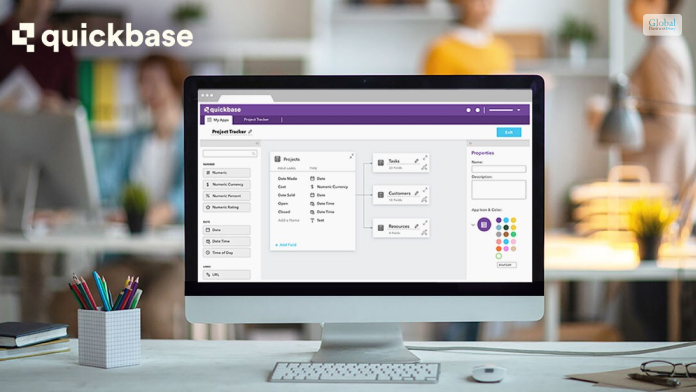
QuickBase is a great software platform that allows you to streamline the work related to business management, lead management, and resource management for better work processes. This software platform is a no-code platform where you can empower your business teams to create, modify, and customize applications despite not having major programming skills.
In this article, you will learn some basic details about QuickBase, which you need to be aware of if you try to purchase the software for your business. In addition to the pricing of the software, you will also learn about the major features of the software platform, which you can find after your QuickBase Login.
Hence, you shall find out whether this software is a good option for your business or not. Finally, we will discuss some of the major pros and cons of the software. Hence, to learn more about the software, read on through to the end of the article.
QuickBase – What Is It All About?

In the year 2022, Inc. Magazine named QuickBase as the Best in Business SaaS software. This tells you that the company has made a positive impact on society, the environment, communities, and industries. You will have better access to better information. Furthermore, automated workflows and access through permissions can help in enhancing security.
According to the official website of QuickBase,
“A big focus at QuickBase is how to create better connections. Between your people, among your systems and data, with partners and collaborators. And that connection can – and should – go even further when you are truly effective.”
Basically, QuickBase allows you to get all aspects of your business operations in one place. This acts as a centralized system that everyone can access. On the other hand, you will also have a better idea of what is happening at every stage of the business organization.
Once you start using QuickBase, there shall be less risk for your organization, and you will be able to reduce the amount of waste that your organization generates. This, in turn, can help you to cut down your costs, as you can connect the existing systems of your business with the key contributors.
Read More: Zoho CRM – Best Features, Pricing, Pros, Cons, And Alternatives
QuickBase Pricing
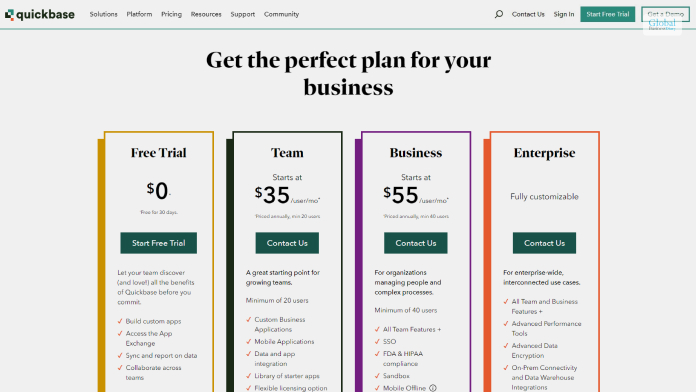
Provided the types of functions that QuickBase offers for businesses, the price looks quite affordable. Furthermore, once you try to purchase the basic version of the app, you will be able to use the app for a period of thirty days as a trial, where you will get all the features available at higher levels. Here are the pricing levels of QuickBase:
| Plans | Pricing |
|---|---|
| Team | $35 per user per month (annual billing) for a minimum of 20 users |
| Business | $55 per user per month (annual billing) for a minimum of 40 users |
| Enterprise | - Fully customizable software- Price as per the types of services availed.- For the whole enterprise and interconnected use cases. |
QuickBase – What Are The Major Features That It Offers?
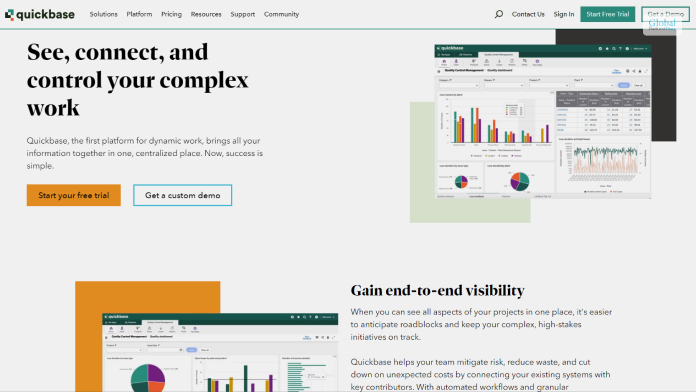
QuickBase helps you streamline the processes of the organization, and your teams can also improve their complex business application. Furthermore, here, you will not need to worry about the cost of traditional development, maintenance, and deployment of resources.
Here are the major features:
- Project management
- Portfolio management
- Resource management
- Budget and Finance
- Contract management
- Work-order management
- Subcontractor management
- Reports and Analytics, and many more.
Why Can QuickBase Be A Good Option For Your Business?
As per the claims of QuickBase’s official website,
“QuickBase helps your team mitigate risk, reduce waste, and cut down on unexpected costs by connecting your existing systems with key contributors. With automated workflows and granular permissions, the right people will have access to the right information every time.”
Apart from that, there is also QuickBase Training which you can avail of to become an expert with the software. Once you start using the software at all levels for the business, it will help in simplifying the processes. It also comes with a variety of options for integrations as well, as you can connect with all the QuickBase software systems, as well as third-party systems.
Essential Pros And Cons Of QuickBase

Like every other software platform, QuickBase also comes with its own set of pros and cons that are essential for you to know. The following are the major pros and cons that you will need to know about QuickBase:
Pros Of QuickBase
Here are the major pros of QuickBase, which shall surely benefit your business processes:
- The platform has very proactive and outgoing product support.
- There is a large user community forum, which is brisk. Here, you will be able to learn a lot about the software and clear your doubts as well.
- There are many customization options that allow you to personalize the software based on the needs and demands of the business.
- The reporting and analytic functions are plenty, and they are powerful as well. Such features can help you to make data-driven decisions for your organizations.
- There are plenty of integration possibilities with third-party applications as well.
- There are a variety of permission levels that can enable you to maintain better control of your business.
Cons Of QuickBase
The following are some of the cons of QuickBase which you need to be aware of if you are thinking about making a purchase:
- The software has many features and can get complicated in certain cases. Hence, there is a steep learning curve at the start.
- The mobile app is not so great and lacks functionalities and features.
- The budget and financial management tools are limited.
- There are some problems with the tables, as retrieving data can be difficult.
- If you want a summary of configuration information, it is not possible.
- Creating dynamic forms is complicated.
Read More: Freshworks – Best Features, Pricing, Pros, And Cons: Let’s Discuss
Summing Up
Hope this article was helpful for you to find out whether QuickBase is a good option for your business or not. We think it is. If yours is a small business, this is great software to manage your business processes easily. What are your own reviews about the software? Share with us in the comments section below.
Read Also:
Tags:

Recent
Memory Chips Are Becoming More Important in the AI Era
Aug 06, 2026

Why Enterprise Web Applications Still Choose Angular for Long-Term Growth
Aug 04, 2026

Due Diligence Decoded: Why Careful Evaluation Still Wins in Business
Jul 11, 2026

How Hydraulic System Design Impacts Equipment Performance
Jul 01, 2026

Related Articles

Breaking Into Fintech: Skills For Fintech Essential for Aspiring Professionals
The Fintech industry has evolved at a faster pace over the last few years. Candidates are now aspiring to build their fintech careers in this field. Now, you may also be the one who is doing the same as well. In such a scenario, you need to know skills for Fintech that can help you to grow. A career in fintech can offer you a wealth of opportunities to steer your business in the right direction. It's a field that has piqued the interest of many job seekers. Particularly those with a passion for pursuing exciting roles in the Fintech Space. If you're considering a career in the Fintech Domain, it's essential to possess not only the right skills but also understand the market needs. This understanding will be instrumental in aligning your career goals with the industry's demands. Skills For Fintech Essential to Build Your Career in This Field There are certain skills for Fintech that you must know while building your career in this field. Some of the key skills that you should have to prosper and flourish in this domain are as follows: - 1. Technical Expertise Fintech is a highly tech-driven industry, so there is no doubt that your technical skills will be in high demand here. This includes the fact that you must have knowledge of certain programming languages to build your career here. Some of the key programming knowledge that you should have in this domain is Python, Java, and C++. You need to be completely familiar with API, cloud computing, and databases. Additionally, the knowledge of machine language will be of added advantage for you in this sector. Evolution Of Fintech is increasing the demand for this type of professionals. 2. Having Financial Knowledge Anyone working in Fintech should have a strong financial knowledge in the Fintech sector. This includes all the knowledge of things like payments, banking, risk management, and investing. Once you develop financial knowledge in this field, things will become easier for you. However, some companies hire chartered accountants and auditors to build a strong career in this field. You need to be well accustomed to it while meeting your career goals in this field. 3. Analytical Skills Fintech businesses generate a lot of data, so you need to be well-equipped with analytical skills. You need to identify the trends that can help you build your career in this field with complete ease. An individual must be well-versed with skills in statistics, machine learning, and data mining. Therefore, if you want to become a successful professional in Fintech industry. Then, you must sharpen your skills in these areas. 4. Problem Solving Skills The Fintech industry is evolving at a constant pace, so you need to think creatively and solve problems with ease. You need to develop your problem-solving skills to help your customers identify the best solution with innovative solutions. Global Fintech companies follow this pattern. Without the knowledge of appropriate problem-solving skills, you cannot sustain or flourish in this industry. Customers may have different types of financial issues and problems you need to hear them patiently and solve them aptly. 5. Communication Skills Strong communication and collaboration skills are vital for the Fintech industry. You must have the ability to communicate complex financial concepts to both technical and nontechnical audiences. Ensure that you possess strong communication skills. This can help your career move in the right direction, especially in the Fintech industry. It is one of the crucial skills for Fintech that you must be aware of. Fintech Careers Available In 2024 There are several types of Fintech careers available in 2024 that you must be aware of. Otherwise, things can become more complex for you in the long run. Without knowing the facts, things can turn worse for you. 1. Data Science & Analysis Transformation of the data is one of the crucial aspects of the Fintech business. A data scientist needs to have the requisite skills to analyze the data and make inferences to use it properly. Job Roles Of Data Scientist in Fintech Business Making critical decisions regarding invoices. Monitoring Data Transfer. Keeping track of buying and bookings. Making a Proper analysis of trades and subscriptions. Salary Scale of Data Scientist in Fintech Business As per Glassdoor data, a data scientist in the Fintech business earns between $118k and $200K/ year. 2. Quantitative Analyst To arrive at any financial conclusion, quantitive analysts have to make use of mathematical and statistical data. Fintech Business HR makes the recruitment of Quant experts. You need to be good at quantitative analysis to reach financial conclusions. Ant group also maintains this process of hiring. Job Eligibility Required for Quantitative Analyst In Fintech Business It is essential to have quantitive skills in statistics. You must have strong technical skills. Learn AI, machine learning, and programming skills. Salary Scale Of Quantitative Analyst In Fintech Business As per the data of Payscale, a Quantitative Analyst should a pay scale of $94,584 per year. 3. AI & ML Artificial Intelligence and Machine learning can become your industry while you seek the benefits from the data scientists. Many industries are now willing to work with machine learning professionals to perform the data mining process more easily than ever. Job Roles Of Machine Learning Expert in Fintech Business Making proper application of the AI tools. Using AI tools to grab the refined data from the market. Making accurate and fast decision-making. Salary Scale of a Machine Learning Expert In Fintech Business The salary scale of a Machine learning Expert in a Fintech Business is $97,476 per year. This is as per payscale data. 4. Governance Risk & Compliance GRC can make compliance in the process of Fintech business easier and more effective. You need to develop your skills in this segment as well. There are certain key responsibilities you need to shoulder in this sector. Some of them are as follows: - Job Responsibilities of GRC Officer in Fintech Business: - Monitoring compliance with the business using digital tools. Bringing Ci and ML in the picture. Application of Super-fast algorithms to handle any sea of transactions. Salary Scale of A GRC Officer In Fintech Business The salary scale of the GRC officer in the Fintech business is $125000 annually. You must be aware of it while attaining your requirements. Career Strategies You Can Adopt to Build Your Career in Fintech There are certain career strategies you can adopt to build your successful career in the Fintech business. You must be aware of it while reaching your requirements with complete ease. Some of the key factors that you should know here are as follows: - Explore subsectors like payment, Blockchain, Insurtech, and wealth management to build your skills in this area. Target the ideal companies who look for a strong market presence as well as innovation. Bridge up the knowledge gap by developing skills in Cybersecurity, data analysis, and Blockchain Fundamentals. Sharpen your financial literacy to build your business knowledge with complete ease. Ensure that you follow the right path to develop Fintech skills. Final Take Away Hence, if you want to grow your career in the Fintech Sector. You must be aware of the above-mentioned facts. Otherwise, things can turn worse for you in the long run. It would be better if you could share your feedback with us. Share your opinion and feedback with us in our comment box. This can boost your chances of getting more relevant information about this industry next time. For More Business Related Articles Click Below!! 5 Essential Aspects That Every Small Business Needs How To Choose The Right Stocks: Tips For New Investors How To Start A Concession Stand Business? – A Complete Guide
Mar 29, 2024

Beyond Stickies: Innovative Note-Taking Apps For Mac Enthusiasts
Apple’s humble Stickies application has served Mac users well. It has allowed users to quickly record an idea, save essential details, create a reminder, or keep critical information visible on the screen while they work. Although it does the job, the Stickies app may feel clumsy because it is a decade-old application that hasn’t received any significant updates in recent years. Therefore, it is natural for Mac users to feel they deserve more, and they do. Fortunately, there’s a vibrant ecosystem of note-taking applications waiting to be explored. You don’t have to singularly rely on Stickies to ignite your creativity and streamline your workflow. Let’s take a look into a world beyond Stickies. Unclutter Do you want a personal productivity sidekick? Unclutter comes to mind. It lends a hand without getting in the way. You can stick the notes above the desktop and access them whenever you want with a single gesture. If you need to revisit something you had copied a while ago, you can dip into the Clipboard History. With Unclutter’s Quick Notes, you can instantly jot down something that is going on in your mind or something you heard during a meeting without opening a full-fledged text editor. There’s also the File Hub for all those random files that keep multiplying on your desktop. Hence, you don’t have to frantically search for them anymore. Post-It Post-It is another popular sticky notes application that gives competition to Apple’s Stickies. This software has got your back, whether you are great at collaboration and teamwork or need a push for your to-dos. With this application, you can maintain your momentum while working or distance learning as a student. The software is capable of generating ideas with coworkers or organizing homework for your teachers. You can even create eye-catching, vibrant calendars and give them to your friends. To make the note interactive, you can add photos. When it comes to sharing, this software gets along with everyone. You can export all your notes without a fuss to your preferred cloud services or third-party programs, such as iCloud, Trello, Miro, etc. Bear Do you love the elegance of plain text but want richer formatting? This is where Bear comes to the rescue. This is a stunning application that harnesses the power of Markdown. It allows users to style their notes with simple, effortless keystrokes. You can create nested lists, drag and drop pictures, and even embed code snippets with a lot of ease. The user-friendly, minimalist interface and dark theme of Bear offer a distraction-free zone for crafting code, prose, or anything that comes to your mind. Whether you are a programmer conjuring algorithms or a novelist weaving intricate thoughts and worlds, Bear can be your trusted sidekick. Ulysses Are you a long-form writing enthusiast? When it comes to crafting prose, Ulysses is your best friend. This is a user-friendly, elegant application offering distraction-free writing modes. It provides focus goals so you can stay on track. Also, the app comes packed with organizational tools so you can structure your next magnum opus. Sheets is a fascinating feature of Ulysses that helps break down one’s writing into easily readable, manageable chunks. There’s the goal board that keeps the vision front and center so users never feel lost in their mission. With Ulysses, you can instantly say goodbye to all the clunky word processors and enjoy the minimalist beauty of this application. Allow your words to flow freely! Evernote Does Evernote need an introduction? This has become one of the most widely used note-taking applications in recent years. The latest iteration of the application deserves a standing ovation because it has reinvented itself by offering robust organizational tools and a sleek interface. The app even allows for cross-platform syncing. Within the expansive world of Evernote, you can create to-do lists, capture audio notes, scan documents, and clip web pages. The application is ideal for professionals, students, and anyone juggling several projects simultaneously. Read Also: Higher Education And Business Triumph: What’s The Connection? Obsidian Obsidian is more than a note-taking application. It is a knowledge palace that is waiting to be built. The mind-blowing application leverages linking notes to create a web of interconnected ideas. Although each note has a separate identity, they can be seamlessly connected to each other through bi-directional links. The links can be discovered visually. The application is ideal for students, researchers, and anyone who loves mapping out complicated ideas and forging intellectual connections. Notability Notability is another excellent application for Mac users. But it is not merely a note-taking application. The tool captures the entire thought process. It seamlessly blends typed text, sketches, handwritten notes, pictures, and even audio recordings in a single note. Users can unleash their creative side by importing web pages, annotating PDFs, and doodle diagrams. Conclusion So, these are some popular note-taking applications you can consider if you are seeking something better than Stickies. Read Also: The Resources You Need To Start Your Business How To Start A Business In 2021 – Best Business Strategies Everything Any Entrepreneur Needs To Know Before Starting A Business
Jan 31, 2024
Strengthening Corporate Sustainability Through Smarter ESG Reporting
The Shifting Ground of Sustainability Climate worries are not background noise anymore. Rather, they are loud, constant, and shaping how companies move. Resources feel tighter, expectations heavier, and boards and managers cannot just talk about responsibility. They are being asked to show it, prove it, and keep proving it. That’s where ESG reporting steps in. Environmental, social, and governance metrics are not just numbers on a sheet but signals and evidence of whether a business is serious about its footprint, its people, and its ethics. The reporting process, when done right, forces visibility and accountability. Why ESG Reporting Matters? Primarily, ESG reflects how a company operates across three major pillars, which are environment, social responsibility, and governance. In fact, it includes data collection, cleaning, and transparent presentation. This shows that it is more than compliance. Basically, it is a way of saying, “Here’s how we are doing, here’s where we are falling short, and here’s what we are fixing.” Meanwhile, digital platforms make this less of a headache by pulling information from across departments. It then stitches it together and gives leaders a sensible dashboard. Tracking energy use across facilities Monitoring workforce diversity metrics Mapping supply chain risks These are not merely checkboxes, but are levers. Hence, pulling them changes how the business runs day to day. Embedding ESG into Everyday Choices The real shift happens when ESG is not treated as a side project. When metrics are baked into decisions, like procurement, hiring, and product design, the company’s sustainability efforts stop being reactive and instead align with long-term strategy. As a result, compliance gets easier, ratings improve, and investors notice, customers too. Hence, a business with strong ESG performance often shows higher integrity, stronger accountability, and sharper awareness of its impact. It’s not just about looking good in reports. It is also about running cleaner and smarter operations. Tangible Improvements, Not Just Ideals Practically, transitioning to renewable energy cuts costs over time. Also, investing in diversity builds stronger teams. Meanwhile, responsible supply chains reduce risk. These are not abstract but measurable benefits. In fact, companies that lean into ESG mostly find themselves more resilient when markets shift. As a result, they adapt faster, innovate more, and avoid the drag of outdated practices. Major Financial Outcomes Tied to ESG Money always talks, and ESG performance has started to speak the same language. In fact, investors and consumers mostly prefer companies with visible sustainability commitments. Studies across industries keep pointing to the same trend. They say that strong ESG scores mostly correlate with better financial returns. But beyond numbers, there is brand trust and the ability to form partnerships that would not exist otherwise. In crowded markets, ESG can be the differentiator that makes a company stand out. Technology As the Backbone Managing all this requires reliable data, and ESG reporting software has become the backbone. Actually, automation reduces manual errors. Meanwhile, real-time visibility means leaders do not wait for quarterly updates to act. Moreover, energy-tracking features highlight inefficiencies: Old HVAC systems Poor lighting Water waste. Hence, fixing these does not just cut bills. Rather, it pushes environmental goals forward. Older facilities especially benefit since outdated systems tend to bleed resources. From Compliance to Continuous Improvement The bigger picture is evolution. ESG reporting tools let companies move beyond compliance by helping set smarter goals, track progress with precision, and communicate achievements without spin. This alignment between sustainability and operational strategy creates a cycle of improvement. Hence, it is not static but an ongoing process. Looking Ahead Global expectations are not slowing down. Companies that invest in ESG technology now are building stability for the future. The payoff is not only environmental, but it is growth, resilience, and credibility. This is important in a world where sustainability and profitability are no longer opposites. Rather, they are intertwined, and businesses that recognize this early are the ones most likely to thrive. For more on this, check out the resource below from Donnelley Financial Solutions, a virtual data room provider. Read Also: What Is Fintech? Defining The Term And Its Core Areas Of Application A&TA: Why Is It Important for Your Business Growth and Performance?
Nov 21, 2025
Less Annoying CRM – Pricing, Features, Pros And Cons, And More
CRM software systems are crucial for any organization nowadays, as it helps a business to track every communication feature and maintain their relationships with their clients. A good CRM comes with a multitude of related software spreadsheets, docs, databases, and portals, which helps the business to manage time and track the data of the client better. If you are looking for something like this at an affordable price, Less Annoying CRM can do the job for you. In this article, you will learn about Less Annoying CRM, which is turning out to be one of the major CRM software systems available online. Apart from that, you will come across a review of the software, in addition to a brief discussion of the features as well. Additionally, you will also learn about the major pros and cons of the software. Hence, to learn more about Less Annoying CRM, read on through to the end of the article. Less Annoying CRM – A General Overview One of the first things that you see about Less Annoying CRM is that it is priced only at $15 per month. There is no extra pricing, and there is no other premium or free version. However, you might get a trial period at the start. No pricing tiers help to reduce the complexities of the software. The CRM is one of the most flexible options that is available in the market. The CRM is mainly targeted toward small to medium-sized businesses and startups. The interface is simple but comprises a many features that are enough for a small business to use. Furthermore, the support from the platform is also quite great. When it comes to lead management, the Less Annoying CRM software is one of the best you can have. According to their official website, “Our simple lead report shows you an always up-to-date list of every lead in your pipeline, including the status and priority of the lead, contact info, and the note from the last time you talked to them. Finally you can be sure that you and your team are following up with all of your leads.” If you are looking for a high-performing CRM at an affordable price, then Less Annoying CRM is probably the best option for you, available online. Although it does not have the features available with Zoho CRM, it still stands out in terms of affordability and the features according to the price. Read More: CRM software Monday: Features, Price, Pros & Cons of Monday Sales CRM Why The Less Annoying CRM Is A Great Option For Small Businesses? One of the best things about the Less Annoying CRM is that it enables easy collaboration between all the members of the company, as well as between the company and the clients. According to the official website of Less Annoying CRM, “Add as many users from your company as you want for just $15/user/month. Each user has their own login and password, and you decide who has access to what. Whether you want your reps to only have access to their own data, or you want everyone to share, we make it easy.” Other major factors that make Less Annoying CRM a great option for small and medium-sized businesses include its easy-to-use interface and simple setup features. With a little learning, anyone shall be able to use the software. It takes only a few minutes for a person to start using the software. Furthermore, if you are struggling to use it, there is outstanding customer support who is willing to help you anytime. The Major Features Of Less Annoying CRM A tech website named TrustRadius.com reviews Less Annoying CRM, as they add, “It is designed for small business looking for a way to increase sales and get organized, but that find other CRMs on the market too complicated. Less Annoying CRM provides tools to track contacts, leads, and follow-ups without any of the extra clutter.” Hence, you can understand that the developers tried to make the CRM more organized and simpler. The following are the major features of Less Annoying CRM that your business shall benefit from: You will get all your contact information in one place, which is an essential demand for contact management. The calendar and tasks are simplified and kept together in one place for the whole team. Lead management is easier, as you can stop leads from slipping between the cracks. Collaboration with others within the company gets easier by a huge margin. There are a lot of customization features that can be done by anyone. You will be able to access information from any device. The Essential Pros And Cons Associated With Less Annoying CRM Every CRM software you will come across online has its own set of pros and cons. You will need to check whether the pros are good enough for your business and ensure that the cons cannot affect you. The following are some of the major pros and cons associated with Less Annoying CRM: Pros These are the essential pros of Less Annoying CRM that can help your business: The interface is interactive, intuitive, and simple. Recently, it was newly redesigned. There are a variety of help and support options from which you can benefit from. Ability to use it from mobile as well. Cons The following are some of the cons of Less Annoying CRM: It can be a bit difficult for an absolute beginner to learn. The new interface can even require a learning curve for existing users too. Some work is needed to upgrade the basic reporting features of the CRM. Read More: Upwards Review: Is This India’s Best Instant Loan App? Summing Up Hope this article review was helpful for you in getting a better understanding of what the Less Annoying CRM software has to offer. It is good software and affordable simultaneously. The best part is that there is no complicated pricing, and also the features are kept fully simple. Furthermore, you will also get the required flexibility and performance, which will help you by providing extra value to your business. Do you think the Less Annoying CRM is a great option for a startup? Share your reviews about this CRM in the comments section below Read More: StashFin Personal Loan Review – Interest Rates, Loan Amount, Eligibility, And More SmartCoin: Information, Eligibility Criteria, Interest Rates, Review & More LoanTap: Information, Eligibility Criteria, Interest Rates, Review & More
Jun 08, 2023