





Where Distributors Lose Profit Without Realizing It

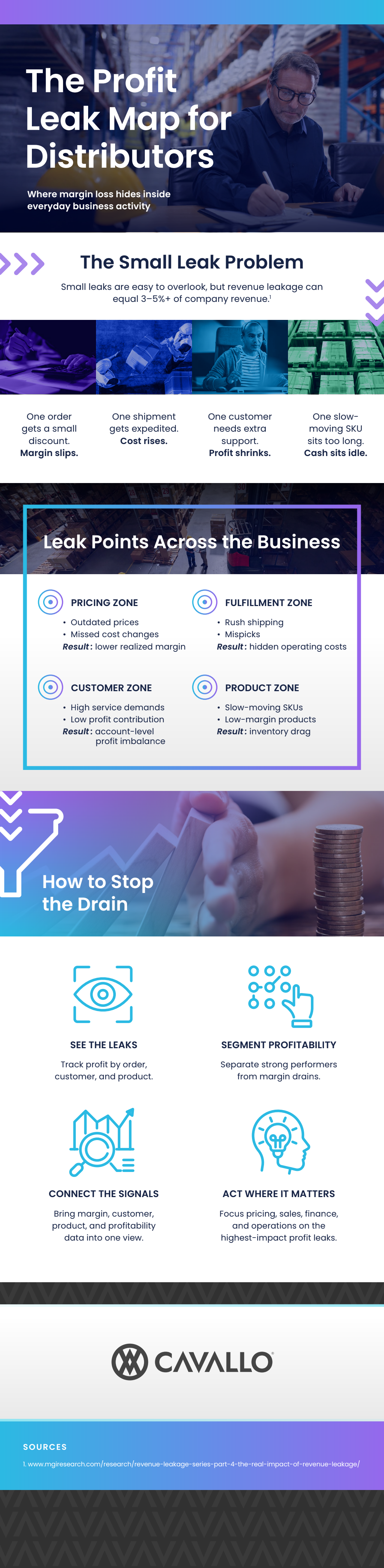
Most distributors don’t wake up one morning and discover a major profit problem. That’s usually not how it happens. Profit loss tends to show up quietly. A small discount here. An expedited shipment there. A customer request that requires extra handling. Individually, none of these things seems serious. In fact, they often feel like normal business activities. But over time? They start adding up. And before you know it, margins begin shrinking without any obvious explanation. And that is where the earning profit becomes so challenging in this industry. You won’t see hidden risk factors in daily operations. And this makes them difficult to spot until the financial impact becomes impossible to ignore.
The Hidden Cost of Everyday Operations
Most distributors focus on major financial metrics. Such as the revenue growth, the order volume, and the Inventory turnover, basically all important numbers. But profit doesn’t disappear through major events alone. Sometimes it slips away through routine activities that nobody questions.
Think about a customer who regularly requests special pricing. Or an order that requires multiple adjustments before shipment. Or a products still sitting in the inventory unexpectedly. Though these events seem alarming, each comes with a cost. And when these costs repeat, it hits a hard blow to your company’s profit. The tricky part? These activities often become accepted as “just the way things work.”
Why Small Inefficiencies Matter More Than You Think
A lot of distributors underestimate the impact of small operational inefficiencies. After all, what’s the harm in one extra shipment adjustment? Or one additional support request? Not much. But that’s not how profitability works. The issue isn’t a single exception. It’s hundreds or thousands of exceptions happening throughout the year. A small pricing concession may seem harmless. But here’s the thing. You start rolling out those discounts like it’s no big deal, and suddenly your margins begin to erode. And yeah, inventory carrying costs? They quietly pile up when products just sit on the shelves longer than you planned. Before you know it, you’ve got this slow financial drain sucking away at your bottom line. It feels sneaky, almost invisible, until those profitability reports pop up and make everyone scramble. Have you ever noticed how these things creep in without warning? By then, finding the root cause becomes much harder.
The Problem With Siloed Data
Here’s where many distributors run into trouble. They have data, a lot of it. Such as the sales data, the inventory reports, customer records, purchasing costs, and financial statements. The information exists, the problem is that it often exists in separate systems. Sales teams focus on revenue, and the operations teams focus on fulfillment. Customer service focuses on resolving issues, and Finance focuses on margins. Everyone is doing their job. Yet nobody is seeing the complete picture. And when information stays isolated, profitability insights can easily fall through the cracks. That’s when businesses start making decisions based on partial information instead of the full story.
Revenue Doesn’t Always Equal Profit
This is one of the biggest misconceptions in distribution. Higher revenue feels like success. And sometimes it is. But not always. A customer generating significant sales volume may also require:
- Frequent order changes
- Special pricing agreements
- Rush deliveries
- Additional customer support
- Customized fulfillment processes
Suddenly, that high-revenue account may not be as profitable as it appears. The same logic applies to products. Some products rack up solid sales numbers, sure. But to be honest, they quietly eat up way too much warehouse space, labor hours, and inventory cash. Just staring at revenue? That won’t show you any of those hidden costs sneaking in. That’s exactly why you need a broader take on profitability analysis. You gotta look at not just how much revenue a customer brings in, but also what it actually costs to serve them.
Understanding the True Cost to Serve
Not all customers cost the same. And that’s okay. The challenge comes when businesses fail to measure those differences. For example, two customers may purchase identical products and generate similar revenue. At first glance, they appear equally valuable. But one customer places predictable orders, pays on time, and rarely requires assistance. The other constantly requests exceptions, changes orders at the last minute, and requires extensive support. Who is more profitable? The answer becomes obvious once you consider the full cost to serve. That’s why leading distributors increasingly analyze customer profitability rather than focusing solely on sales performance. The insights can be surprising. Sometimes your biggest customer isn’t your most profitable one.
How Inventory Impacts Profitability
Inventory is often one of the largest investments a distributor makes. Which means it deserves attention. Products sitting on warehouse shelves may still generate sales eventually. But while they’re sitting there, they consume resources. This includes storage space, the insurance costs, the handling expenses, and the working capital. The longer your inventory just sits there collecting dust, the harder it hits your finances. You know what I mean? Profitability isn’t only about selling more stuff. It’s also about handling your inventory the smart way. Distributors who regularly check how their products are actually performing usually spot those slow-movers before they turn into a real headache. And that early visibility? It hands you solid opportunities to fatten up your margins.
Using Data to Make Better Decisions
The most successful distributors don’t wait for month-end reports to tell them something is wrong. They build visibility into daily operations. That means looking beyond broad financial summaries and analyzing performance at a more detailed level.
For example:
- Which customers generate the strongest margins?
- Which products create the highest returns?
- Which territories perform best?
- Which operational exceptions occur most frequently?
- Which sales activities drive long-term profitability?
These questions matter. Because when you understand what’s driving profit, you can make smarter decisions much faster. Instead of reacting to problems after they occur, you start preventing them before they grow.
The Role of Profitability Software
As distribution businesses grow, tracking profitability manually becomes difficult. There’s simply too much information. Too many transactions, then too many products, and then too many customer interactions. That’s where profitability software really steps up and makes a difference. Modern tools pull together your customer info, inventory levels, pricing, operations, and financial numbers all into one single view. Forget juggling those disconnected reports. You finally get the full, clear picture of what’s happening in your business. Feels like a breath of fresh air. Patterns become easier to identify. Trends become easier to spot. And decisions become easier to support with data. The goal isn’t just better reporting. It’s better decision-making.
Turning Insights Into Competitive Advantage
Here’s something worth remembering. Most profit leaks don’t come from dramatic mistakes. They come from small inefficiencies that become part of everyday operations. That’s actually good news. Why? Because small problems are often easier to fix once you can see them. A recurring pricing exception. An inefficient process. A slow-moving product category. A customer account with hidden servicing costs. Addressing these issues doesn’t usually require major disruption. It simply requires visibility. And visibility creates opportunity.
Final Thoughts
Profitability isn’t something that happens at the end of the month. It’s shaped by hundreds of decisions made throughout the day. It can be the pricing decision, or the inventory decision, and also the operational decisions. Each one matters. That’s why the most effective distributors look beyond revenue and focus on the bigger picture. When you connect customer data, inventory activity, operational performance, and financial results, hidden profit leaks become easier to identify. And once you can see them? You can fix them. Because in distribution, the biggest profitability opportunities are often hiding in places you least expect.
Read Also:

Recent
Dinmukhamet Idrisov and a Gold-Mine Dispute From Kazakhstan’s Oligarchic Past
Oct 16, 2026

Memory Chips Are Becoming More Important in the AI Era
Aug 06, 2026

Why Enterprise Web Applications Still Choose Angular for Long-Term Growth
Aug 04, 2026

Due Diligence Decoded: Why Careful Evaluation Still Wins in Business
Jul 11, 2026

Related Articles

The Best Reputation Management Companies – How To Choose One?
Reputation management companies are the ones that ensure that the image of the business is at a top level on both online platforms as well as offline. Although offline reputation is important, in this digital age, it is very important for businesses to ensure their online reputation. Hence, you will need to find the best reputation management company that will ensure you have a good image online. In this article, you will learn about online reputation management companies and how they work. We will discuss a variety of aspects related to these businesses and how these businesses promise to offer services to you and deliver at the same time. Finally, we will share with you brief details about the best online reputation management companies with whom you can work to ensure a good online image. Hence, read on to learn more. What Are Reputation Management Companies? According to NeilPatel.com, “Consumers are creatures of research. We often don’t believe something unless we see it for ourselves—or hear it from a trusted source. [...] your online reputation is more important than ever. Online reputation management usually translates into businesses trying to get as many reviews as they can without a plan or strategy to handle everything else that comes along with reputation management.” The reputation of a company is critical to its success. As customers are turning more to online platforms for services or to share their experiences on social media, businesses need to maintain a positive image on such platforms. Hence, it becomes necessary for businesses to be proactive in maintaining their online reputation. This is where the role of online reputation management companies comes to the fore. Read More: What Is Continuity In Business, And Why Is It Important? How Does A Reputation Management Company Work? According to an article on LinkedIn.com, “When choosing a reputation management company, it is important to consider your specific needs and budget. It is also important to get quotes from multiple companies before making a decision. By working with a reputable reputation management company, you can protect your brand and enhance your online reputation. This will help you attract new customers, retain existing customers, and grow your business.” The specialty of reputation management companies is to help businesses monitor, respond to, and remove negative content related to their businesses on online platforms. The companies can also help your business create positive content for your business which helps in making the negative content negligible. Hence, it is important to choose the best reputation management company for your business. What Are The Best Reputation Management Companies? According to QuickSprout.com, “Online reputation management services can help you build a positive brand image or repair a damaged one. This isn’t something you want to try to accomplish on your own for the first time unless you really know what you are doing. Booking a call with one of the best online reputation management companies will save you time and money and set your business up for success.” The following are the best reputation management companies that you will need to learn about: 1. NetReputation This is one of the best reputation management companies and won awards in 2020, and 2021. If you want to remove negative content about your brand on various online platforms, NetReputation is the way to go. They also help you to fix inaccurate business listings, as well as the visibility of your assets. 2. Podium Apart from reputation management, Podium focuses on review acquisition as well. The best thing about this brand is that it has plans for all types of businesses, regardless of their industry and size. Their focus is to improve the online review process and streamline the operations. It also has the capability to centralize all its reviews from review websites like Google and Facebook into one location. It comes with software that allows you to take advantage of a centralized inbox, where you can compile all reviews and messages from social media platforms and filter them for online presence. 3. Webimax Reputation management is the core specialty of Webimax. The company has been protecting its online reputation from many companies for more than two decades. Apart from that, the company also offers reputation management for individuals as well. One of the factors that make this company stand out is that they offer really good customized solutions. The company can also help you find out what plans fit your budget and goals. Apart from that, they keep the process fully confidential and operate with a non-disclosure agreement. 4. Gadook Apart from reputation management services, Gadook also offers inbound marketing services. This company also offers reputation services for an individual as well as CEOs, chairmans, founders, company presidents, etc. Gadook also helps you build your brand and offers services like rebranding, brand protection, review management, and social media protection. If you want to know which services you need, Gadook will provide an analysis of your current state. 5. Reputation Defense Network This is one of the best platforms to choose if you want to remove false content about your brand that is present online. This reputation management company is different since it does not take payment once the work is not done. You do not need to pay any upfront cost, and if they are to permanently remove false content related to your company, you do not pay at all. This company focuses only on the removal of content and not generating content. Read More: Business Continuity Plan – What Is It, And How Does It Work? Final Thoughts Hope this article was helpful for you in finding the best reputation management companies for your business. You can see from this article that having such companies to your aid always helps, especially when it comes to saving your reputation in the marketplace, especially online. Furthermore, these companies also help you to build your reputation. Hence, if you think that your brand image is a bit damaged online, and you want to save your image, or rebuild your brand image, consider hiring a reputation management company. Consider contacting one of the best options that we have given in the article. Do you know of any other such companies? Share some names with us in the comments section below. Know More About Business! Pro Rata: Definition, Uses, And How To Calculate It? What Is The Leverage Ratio And How to Calculate It? Trial Balance: Definition, Working, Importance, And More
Oct 26, 2023

How To Create A Powerful Strategic Marketing Plan – Step By Step Guide
Are you planning to make a proper strategic plan for developing your business? If yes, then you must have the right business plan and the idea to implement it. Planning is the essential part of framing your marketing strategy. You must not consider things for granted here. You must prepare the proper marketing strategy to develop your brand image. The Forbes study clearly stated that 90% of any business’s success rate depends on its marketing team. A proper marketing strategy will help your business to grow further steadily. You must not consider things casually. If you want to develop your business, you must also focus on developing the right market approach to grow your business. Strategic Marketing can help your business to grow and develop in the right direction. Different Ways Powerful Strategic Marketing Plan Can Grow Your Business If you want to develop a powerful marketing strategy for your business, you must follow specific essential steps to help your business grow in the right direction. Develop a proper strategic marketing technique to develop your business goals. 1. Set Your Marketing Goals And Objectives You must set your marketing goals and objectives first. It will help you to track your performance from time to time. Specific time demarcation is crucial for developing your business. Set some small targets first, like 18 to 24 months. Proper Strategic marketing is essential for growing your business. You must divide your marketing targets into four broad categories like What to achieve? When to achieve? How much time is left to achieve your target? You need to develop the right market approach. All these three questions play a vital role in achieving your business target in a short time frame. You must not shift from your plan to develop your business in the right direction. Try to make a smart marketing strategy that can help your business grow in the best possible manner. Your targets must not be over excessive, that it makes the life of the marketing team difficult. 2. Conduct A Marketing Audit You must conduct a proper marketing audit to help your business grow in the best possible manner. Identify the needs and the wants of your customers. If required, change your service pattern or upgrade your product quality. Review all the aspects of your marketing plan, starting from the marketing audit, planning the proper implementation of the marketing strategy, advertisement plan, budget of branding, and the target audience’s response. It will help you to understand the current market scenario. You cannot For devising the correct strategic marketing plan, you must have the required market knowledge to develop your goal in the right direction. 3. Conduct A Thorough Market Research Thorough market research is crucial for developing the right business plan for your organization. Your marketing research must include the following points while scanning the market for devising an accurate strategic marketing plan. Who is your target audience? What are their needs and preferences? Do they want something news from you? What are the factors your competitors are doing to get the success? Who is your closest competitor? Is your marketing plan is in the right track, or it needs modification? All the above factors play a vital role in developing the right marketing strategy for your business. If you know the answer to these questions, it will help you devise your business’s right marketing plan. A proper market approach is essential. 4. Identify Your Target Audience You must identify your target audience to develop your strategic marking plan. The selection of the demography is the crucial factor in this regard. While you target a particular niche, you must have the following knowledge about your target audience in detail. What is their age group? What is their gender? Are you targeting a particular set of audience that are elite class? How much can they afford to spend their money on your specific niche? All the above factors are very crucial for developing the right marketing strategy for your business. If you want results, then you cannot ignore these facts. You must stay vigilant while devising the marketing strategy of your business. Consider the information of the market intelligence while developing the marketing strategy. 5. Determine The Budget You must determine the budget for your marketing team. You cannot consider things for granted. You must develop a proper marketing plan to help you build your business in the right direction. A proactive market approach is crucial for the development of your marketing plan. You cannot consider things for granted here. You must have the budget separated as per your team’s requirements. In most cases, 3-5 percent of the gross income is estimated depending on your business marketing plan. Proper development of the strategy will help your business to grow in the right direction. You must have enough budget with you to support your business. Why Do You Need To Frame Right Marketing Budget? You must have the right strategic marketing plan to help your business grow in the right direction. You cannot derive the right result for your business if your marketing plan is not correct. You must have the proper strategy to help your business grow in the right direction. Right metrics is essential for developing your business in the right direction. You must not consider things for granted here. Ensure that you have implemented the right business tactics to achieve your business targets. Conclusion Hence, if you want to develop your business, you must devise the right marketing strategy to achieve your business goals quickly. The right marketing strategy can help your business to grow in the right direction. You must frame the right policies that will help your business to grow at the right speed. You must not make any wrong choices from your end. Consider the right analytics to help your business provide the estimated results that will help your business multiply. You must develop the right marketing strategy to help you achieve your business’s desired goals in the most effective manner. A proper marketing strategy will help you to achieve your business goals quickly. Read Also: How To Create A Powerful Business Continuity Plan? How To Make Money Fast – 5 Strategy To Follow In 2021 How to Start a Business in 2021 – Best Business Strategies
Feb 11, 2021

Visa Sponsorship – Everything You Need To Know About It
Do you want to get a Visa sponsorship in the USA? If yes, you need to maintain certain sets of documents that guarantee your working status and job profile, showing that you are a US citizen. As per the country’s norms, if you want to relocate to the US, you must find a job and an employer. Proper documentation here plays a vital role if you want to get the Visa on time. After that, you need to hire a non-resident employee for a particular job profile in your company. Your employer must be aware of the fact that you are not a legal permanent resident of the USA. On your behalf, your employer has to provide the guarantee that you will be a legal resident of the USA to the US Visa department. After that, you will be eligible for a visa sponsorship in the USA. Who Can Sponsor You for The Visa? Ideally, in most cases, your employer can provide you with the Visa Sponsorship only when you are working on the job offer in the name of a US company. In other words, the employer will sponsor the visa and will submit all the essential documents in your name. Only on specific grounds will they make the sponsorship in your name. If an American Company hires you for a specific job position and declares that you must stay in the US to perform your job responsibilities there. The moment you get that offer letter from the US company to work there, you will get the opportunity to get the Visa Sponsorship from your end. You also need to submit the required documents to the Department of Labor. Your employer’s total participation is required if you want to get the Visa despite being a foreign national in the USA. You need to consider these facts if you want to get sponsorship in the USA. Ensure that you have followed all the norms carefully so that your application does not go for rejection. Visa sponsorship USA is the most efficient mode of doing business. Non-Immigrant Sponsorship The non-immigrant sponsorship is used temporarily, where individuals cannot become US citizens. This sponsorship is valid for those people who are moving temporarily to the country. They are not permanent residents of the US. It also means that non-immigrant Visa Holders are not eligible for green cards. This Visa sponsorship USA will not be valid later for the qualification of US Citizenship. You need to travel for a short period from the USA. It will be the ideal Visa Sponsorship for you. You need to have the Employee Authorization Document if you want to work in the US. There are several non-immigrant Visas that it will require the following documents from the employer to get the sponsorship. Some of the essential factors in this regard are as follows in a better manner. H-1B Visa. H-2B Visa. H- 2A Visa. O1A- Visa. L1- Visa. O1B Visa. O2 Visa. These are the different types of non-immigrant visas that you must consider from your end to develop your case for getting the sponsorship. All these factors you must consider from your end to get the sponsorship for the Visa on time. How Can You Get The Immigrant Sponsorship? You can get the immigrant sponsorship for the immigrant Visa and the green card. For the immigrants who hold a Visa sponsorship, they do not require any separate employment authorization. This Visa will enable you to live in the United States and become a country’s legal permanent resident. Some of the standard and most popular immigrant Visas that you can derive from the immigrant sponsorship are as follows:- EB-1, 2, 3, 4 visas are some of its popular visas that you must consider from your end. You cannot ignore these Visa categories as they can prove to be very handy for you at times. Different Steps You Must Follow To Get The Sponsorship Letter You must consider several essential steps for getting the sponsorship letter for your business. Therefore, let’s explore the process to get a better understanding of these facts. The justification and the documentation must be accurate in this regard. Let’s explore the steps to get the right idea of these facts to get a better idea about the services:- The initial step you must consider here is that your employee must get the US employer’s offer. If you are a non-immigrant, you need to produce a proper labor certification for the labor department. You need to submit the petition to the USCIS along with all the documents. With the submission of all the documents, your documents will be processed by the Visa department, and it will take months to provide you with the Visa Sponsorship. If the application is approved and the report is positive, both the employee and the employer must be informed. If your application is rejected, then both the employer and the employee will be informed immediately. You must consider these facts from your end while you are developing your business. All the above factors are crucial for developing your chances of getting the concerned authorities’ visa sponsorship. The visa rejection chances may be due to the employee's qualifications and inadequate documentation from the employee’s counterpart. You must consider every aspect from your end to get the visa on time and effectively. If you want to get the sponsorship on time, then these facts are crucial. Check out this YouTube video: Requirements of US Visa Sponsorship for Employment https://www.youtube.com/watch?v=kUDXjVMHaGo Final Words Hence, if you plan to get the Visa Sponsorship, then you must consider the above things from your end. It will help you to get the Visa on an immediate basis. Ensure that you have correctly followed the norms. It will help you get the sponsorship on time, and you can maintain the norms in the correct order. Ensure that you have followed all the factors properly. The more you can think proactively, the better you can achieve your business goals in a better manner. Ensure that you have not made any mistakes on your end to develop your business correctly. The more you can think positively, the better you can effectively achieve your goals. Also Read: Fiscal Sponsorship – Everything You Need To Know About It How To Make Money Fast – 5 Strategies To Follow Top 5 Successful Serial Entrepreneurs of All Time – Updates 5 Most Powerful Marketing Strategies That Will Change Your Business
Mar 12, 2021

Reducing Micro-Defects in Medical Manufacturing
In medical manufacturing, tiny mistakes don’t stay tiny for long. That’s the whole problem. A barely visible crack. A rough little edge nobody notices at first. Something microscopic. Feels harmless, until the device actually gets used in a real medical setting. And yeah, that changes the stakes completely. That’s why manufacturers obsess over precision now more than ever. Not just during final inspection either. Throughout the entire process. Cutting, machining, finishing, testing, all of it. Because when you’re building medical devices, “almost accurate” is honestly a dangerous place to sit. Why Tiny Defects Become Big Problems in Medical Manufacturing In medical manufacturing, “almost perfect” usually isn’t good enough. That’s the reality. A tiny crack you can barely notice. A microscopic burr sitting on the edge of a component. Slight surface roughness that seems harmless at first glance. In many industries, those flaws might slide through without causing major trouble. But in medical devices? Different story entirely. Because these products interact directly with people. Real patients. Real surgeries. Real outcomes. And honestly, that changes everything. A single micro-defect can affect how a device performs inside the body, how long it lasts, or how safely it functions under stress. Something as small as an uneven edge can interfere with coatings, weaken structural integrity, or create contamination risks during procedures. That’s why medical manufacturing revolves around precision at every level. Not just visible precision either. Deep-level accuracy. Microscopic consistency. The kind most people never even think about. As medical technology continues to evolve, manufacturers face greater pressure to produce smaller, more complex, and more reliable components. So now, reducing micro-defects isn’t just part of quality control anymore. It’s basically part of patient protection. Looking Beneath the Surface Here’s where things get tricky. Many manufacturing flaws never appear during a basic visual inspection. You might hold a component under normal lighting and think everything looks fine. Smooth, clean, and ready to go. But underneath? Problems may already exist. Microcracks can form during machining. Tiny burrs may remain after cutting or drilling. Surface inconsistencies can develop from heat, friction, or finishing processes. And because these imperfections are incredibly small, they often stay hidden until the device experiences stress during actual use. That’s the dangerous part. Even small inconsistencies can create major reliability issues later. A weak point in a surgical instrument may shorten its lifespan. Poor surface uniformity could affect how coatings bond to implants. In some cases, microscopic contamination areas may even increase infection risks. So manufacturers can’t rely only on traditional visual checks anymore. They need deeper inspection systems. More advanced validation. More data-driven monitoring. Basically, they need to look beneath the surface. Literally. Why Conventional Manufacturing Methods Sometimes Fall Short Traditional manufacturing still plays an important role across many industries. But when you’re dealing with ultra-precise medical components, conventional methods can introduce variability that becomes difficult to manage consistently. And variability is the enemy here. Tool wear alone creates problems over time. A cutting tool that worked perfectly during the first batch may slowly lose accuracy after repeated use. Small dimensional differences start appearing. Surface finishes change slightly. Tiny inconsistencies build up little by little. Manual handling adds another layer of risk, too. Human involvement is valuable, obviously, but people naturally introduce variation. Alignment shifts happen. Pressure differences occur. Environmental factors change throughout the day. Even temperature fluctuations inside production facilities can affect tolerances. The weird part? Components may still technically meet standard specifications while microscopic defects remain hidden inside the process. That’s why manufacturers are moving toward more controlled and automated production systems. Not because humans are incapable. But because consistency at this level requires tighter control than traditional workflows usually provide. Advancing Precision Through Modern Technology This is where modern manufacturing technologies start changing the game. Laser cutting, micromachining, automated fabrication systems, and advanced polishing methods all of these help reduce variation while improving repeatability. And honestly, repeatability matters almost as much as precision itself. Because making one perfect part is nice. Making thousands of identical parts consistently? That’s the real challenge. Laser cutting technologies, for example, create cleaner edges with minimal physical contact. That reduces burr formation and lowers mechanical stress during production. Micromachining allows manufacturers to achieve extremely tight tolerances without damaging delicate materials. And fewer secondary finishing steps mean fewer opportunities for additional defects. You also see manufacturers integrating automation into inspection systems now. Not just production itself. Automated vision systems can detect surface irregularities faster than manual inspections. High-resolution imaging tools identify cracks and imperfections invisible to the human eye. Real-time monitoring software tracks deviations during manufacturing rather than waiting until the final inspection stage. That shift matters a lot. Because catching a problem early is cheaper, faster, and safer than discovering it after thousands of parts are already completed. Real-Time Inspection Is Becoming Essential Old-school quality control usually happened at the end of production. Make the part first. Inspect later. But medical manufacturing doesn’t really have the luxury of waiting anymore. Today, many manufacturers use in-process inspection systems that monitor quality continuously while components move through production lines. This creates immediate feedback loops. If something drifts outside acceptable tolerances, teams can correct the issue before it spreads across the batch. Pretty huge difference. Real-time inspection systems may include: Automated optical inspection Surface roughness analysis Dimensional verification tools Laser measurement systems AI-assisted defect detection High-magnification imaging platforms And honestly, this approach saves more than just money. It protects consistency. Instead of reacting to problems afterward, manufacturers prevent them during production itself. That proactive mindset is becoming one of the biggest shifts in modern medical manufacturing. Why Design and Manufacturing Teams Need Better Alignment Sometimes defects don’t start on the production floor at all. They start during design. A component may look perfect in CAD software yet remain extremely difficult to manufacture consistently in real-world conditions. Tight tolerances that seem manageable theoretically may create excessive stress during machining or finishing. That disconnect causes problems fast. So now, successful medical manufacturers push for stronger collaboration between design engineers and production teams from the beginning of the process. When manufacturing realities are considered early, defect risks drop significantly later. Design-for-manufacturability practices help teams create components that maintain both precision and production practicality. Basically, it’s about asking smarter questions earlier. Can this geometry be produced consistently? Will this material respond well during machining? Could this tolerance create instability later? That kind of collaboration reduces surprises before production even starts. Process Control Creates Long-Term Consistency Precision doesn’t happen once and stay forever. It needs constant maintenance. Machines drift over time. Calibration shifts happen. Equipment performance changes slowly, sometimes so gradually that operators barely notice until defects start increasing. That’s why strict process control sits at the center of high-level medical manufacturing. Manufacturers rely heavily on: Scheduled calibration procedures Equipment validation Environmental monitoring Traceability systems Documented workflows Statistical process control These systems create stability across long production cycles. And honestly, traceability has become incredibly important too. If an issue appears later, manufacturers need the ability to trace components back through specific machines, operators, materials, and production conditions. Without that visibility, solving quality problems becomes way harder. To learn more about minimizing micro-mistakes in medical manufacturing, view the resource below from Trinity Brand Industries, providers of laser cutting services. Continuous Improvement Never Really Stops Here’s the thing about medical manufacturing. The standards keep rising. Devices are getting smaller. Procedures are becoming less invasive. Materials are more advanced. Expectations around safety and reliability continue increasing year after year. So manufacturers can’t afford to become complacent. Continuous improvement plays a huge role in reducing micro-defects over time. Teams constantly analyze production data, identify recurring patterns, and refine processes to improve consistency. Sometimes the adjustment is small. A tooling modification. A better polishing method. A slight environmental control improvement. But small changes add up. Over months and years, these refinements dramatically reduce variation and improve reliability across entire production systems. And honestly, that’s what separates reactive manufacturers from truly advanced ones. The Bigger Picture Behind Precision At the end of the day, reducing micro-defects isn’t just about manufacturing efficiency. It’s about trust. Hospitals trust devices to perform correctly. Surgeons trust instruments during procedures. Patients trust products they’ll never even see internally. That trust depends on microscopic precision most people never think about. When advanced fabrication technologies, real-time inspection systems, disciplined process control, and smarter collaboration work together, manufacturers create something bigger than just accurate parts. They create reliability. And in medical manufacturing, reliability can directly influence patient outcomes. That’s why precision here isn’t optional. Never really was. Read Also: How AI Is Quietly Reshaping Pharmaceutical Manufacturing SESteel: Southeastern Steel – Overview And Things You Should Know
May 18, 2026