





CASHe Personal Loan App: Information, Eligibility Criteria, Interest Rates, Review & More

Are you looking for a quick personal loan? Then CASHe is a great option for you, where you will be able to get short-term loans at low-interest rates. This platform is specifically created to offer short-term loans to young-salaried and self-employed people. The loans are of instant disbursal. You can get personal loans, even if you do not have a credit history.
In this article, you will basically learn more about CASHe loans and the major features of the CASHe app. Furthermore, we will also share some of the major reviews of CASHe, which can be beneficial for you to get an idea of the platform in general.
CASHe – How Does It Work?

CASHe is a personal loan app that uses a credit scoring mechanism called Social Loan Quotient, which is based on artificial intelligence. In this mechanism, the CASHe app leverages various alternative sources of data coming from smartphones, social media and others.
Furthermore, monthly salary, education, career experience, and basic KYC experiences. This is mainly done to evaluate a loan borrower’s worthiness of credit.
CASHe App: How To Download The CASHe Loan App?

The following are the steps that you need to follow to download the CASHe app:
Step 1: Go to Google Play Store on your smartphone.
Step 2: Type ” CASHe ” on the search bar and tap on the search button.
Step 3: Click on the app named ” CASHe”
Step 4: Download and install the app.
You can also use the CASHe promo code to get good offers on loans, as well as various graces on the rate of interest. Apart from the app, you can also visit the CASHe official website to see various details of the loan. If you want to get yourself a loan, go to the instant personal loan section, and click on the “Get a Loan” button.
You will need to fill up a form and choose the type of loan you need. Furthermore, you will need to upload scanned documents about your personal details. After all these documents get properly verified, you will get the loan in no time. You can also get the loan within the same day.
CASHe Loan Details
| CASHe Personal Loan Details | |
| CASHe Interest Rate | 2.25% |
| Loan Amount | ₹1000 to ₹4 lakh |
| Loan Tenure | 3 months to 18 months |
| Minimum Age of Loan | 18 years |
| Loan Processing Fee | Up to 3% of the loan amount |
| Minimum Income (Monthly) | ₹12000 |
| CASHe Loan Website | https://www.cashe.co.in/instant-personal-loan/ |
| CASHe Complaints number | Not available on the website |
The CASHe interest rates range from 2.25% per month to 2.5% per month (or 27% per annum to 33% per annum), based on the repayment tenure that you have chosen in terms of your loan. Once you have chosen your loan type, you will only need to pay accordingly.
What Are The Eligibility Criteria To Get CASHe Personal Loans?
Here are the eligibility criteria you will need to fulfill to get an instant personal loan from CASHe:
- You need to be at least 18 years of age. Minors are not eligible to get loans from CASHe.
- Your maximum age should not be more than 58 years.
- You must be at least employed for three months in your current organization where you are employed.
- You should be able to provide valid income proof. Your monthly income should be at least ₹12000 per month.
- You can only get a loan where the loan to value is 30% to 200% of your monthly salary. However, it depends on the type of loan that you choose.
- You can make use of the cashe promo code to get the loans on time.
What Are The Documents Required For Loan Application?
There are several types of documents that are required for the loan application of the Cashe Loan. You must have the following documents with you that you should make use of the Cashe Loan documents while making the application of personal loan.
- Photo Identity Proof as well as PAN card.
- You have to show your latest salary slip and income proof.
- You must use the Aadhar Card or any identity proof.
- Permanent Address proof you have to show to get the loan.
- You need to show up the latest bank statement where your salary is credited.
You need to be well aware of these above factors while you want to get the things done in perfect order. You should take care of the facts that can make things easier and effective for you in all possible manners.
Types Of Personal Loans Available At CASHe

There are various types of personal loans that you will be able to get through CASHe. Different types of loans include car loans, two-wheeler loans, medical loans, education loans, consumer loans, mobile loans, travel loans, and marriage loans. The following are the major types of personal loans options that you will be able to get through the CASHe app:
CASHe 180
| Tenure of the Loan | 6 months |
| Minimum Salary required to be eligible | INR ₹22,000 |
| Minimum loan amount | INR ₹25,000 |
| Maximum loan amount | INR ₹2,10,000 |
CASHe 270
| Tenure of the Loan | 9 months |
| Minimum Salary required to be eligible | INR ₹25,000 |
| Minimum loan amount | INR ₹50,000 |
| Maximum loan amount | INR ₹2,58,000 |
CASHe 1 Year (360 Days)
| Tenure of the Loan | 12 months |
| Minimum Salary required to be eligible | INR ₹40,000 |
| Minimum loan amount | INR ₹75,000 |
| Maximum loan amount | INR ₹3,00,000 |
CASHe 1.5 Year (540 Days)
| Tenure of the Loan | 18 months |
| Minimum Salary required to be eligible | INR ₹50,000 |
| Minimum loan amount | INR ₹1,25,000 |
| Maximum loan amount | INR ₹4,00,000 |
Other Types Of Personal Cashe Loans Availaible Today
There are different types of cashe Loans available today that you must be well aware off. You cannot just make your choices in gray. You need to follow some of the essential facts that can make use of the Personal Cashe loans available for you in all possible manner. Some of the key factors that you must be well aware of are as follows:-
- Instant personal loan.
- Travel loan .
- Two-wheeler loan.
- Mobile loan.
- Marriage loan.
- Home renovation loan.
- Education loan.
- Consumer durable loan.
- Car loan.
- Medical Loan
You can make use of the Cashe Promo code to get some discounts on these mentioned above loans. You must make things work as per your requirements. It will help you to get the desired loans on time. Explore the best loan options that fits your budget and requirements. Otherwise, things can turn worse for you. Cashe offers personal loan based on the loan tenure within a particular point in time.
The details of getting the loans and its procedures you can get from their sites of paisabazaar.com. It will offer you all the complete details how you can afford these types of loans as you need.
Know Before You Borrow: Things to Consider When Choosing Quick Loan Apps
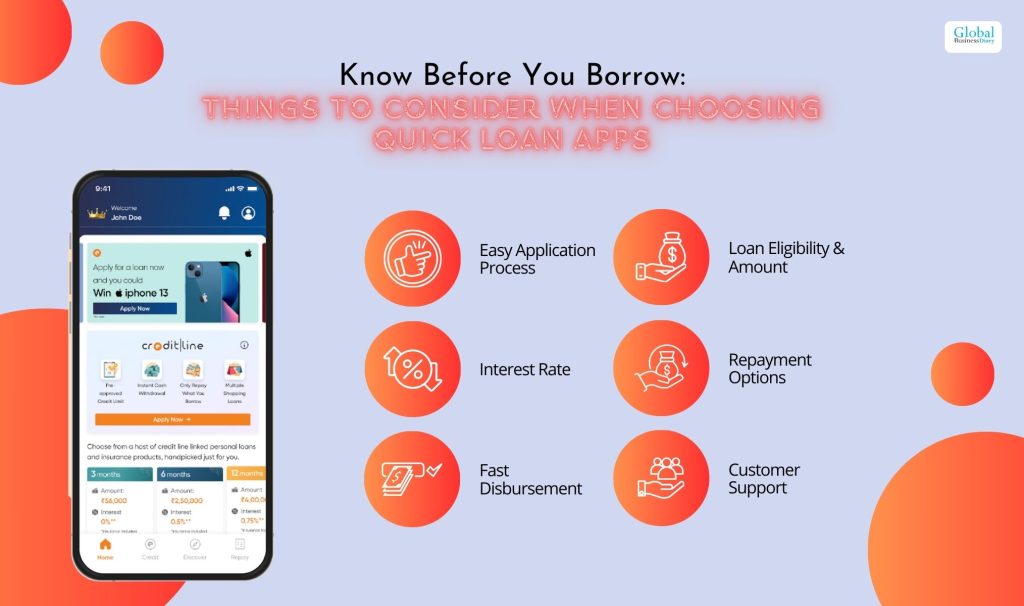
Read about the factors that are considered when it comes to choosing the right app! If you plan to choose a quick loan app, you must check a few things first. It starts with the following factors:
Easy Application Process
When choosing an instant loan app, ensure the application process is simple and easy. The entire process has to be straightforward and user-friendly.
Always avoid apps with complex application procedures and require too much paperwork. You should be able to complete your application process straight from the smartphone.
Loan Eligibility & Amount
Some of the apps are designed for professionals. On the other hand, when choosing an app, ensure it doesn’t put high bars for loan approvals.
For example, many loan apps require a significantly maintained credit score. Some apps require a good credit score, age limit, etc.
Interest Rate
Always ensure you get a good interest rate when taking a loan from an instant loan platform. The interest rate decides the overall amount you have to repay throughout the entire lifecycle of your instant loan. Typical
Repayment Options
It’s best to have a flexible repayment option. The repayment option should suit your financial situation. While some of these instant loan providers offer shorter repayment options, others also offer a long tenure.
If you want flexibility with your loan repayments, you should go for providers that allow an extension on your repayment.
Fast Disbursement
Instant loans are all about your loan getting disbursed as soon as possible. But that’s not always the case. Some instant loan providers often take a long time to disburse the loan amount.
So, when choosing personal loans, ensure you’re getting it from a reliable platform that disburses the loan right after approval. When approved the money should get credited to your account.
Customer Support
In case you are struggling to get the loan approved or want assistance regarding repayment tenures and flexibility, there should be a customer support team helping you.
Whether during your repayment tentures or during application, the customer support team of the loan platform should help you. So, always choose a platform with a reliable customer support team.
CASHe 1.5 Year (540 Days) Reviews – CASHe Review, CASHe Loan Review, And CASHe App Review
Let us go through the reviews that are significant in understanding the apps where you can get a loan. Here are some of the major CASHe loan reviews that you must look for:
Review 1:

Review 2:

Review 3:

Summing Up
One of the things we do not like about CASHe is that there is no CASHe loan customer care number for any types of CASHe complaint. Here, the safety factor goes away completely. However, the reviews for the loan platform are mixed. So, check your loans properly, before you get a personal loan. Share with us in the comments section what you think about CASHe.
Read Also:
Tags:

Recent
Dinmukhamet Idrisov and a Gold-Mine Dispute From Kazakhstan’s Oligarchic Past
Oct 16, 2026

Memory Chips Are Becoming More Important in the AI Era
Aug 06, 2026

Why Enterprise Web Applications Still Choose Angular for Long-Term Growth
Aug 04, 2026

Due Diligence Decoded: Why Careful Evaluation Still Wins in Business
Jul 11, 2026

Related Articles

Wings Of Luxury: Exploring The World Of Jet Charter Within Your Budget
Commercial airlines have seen their service and reputation worsen in recent years. Nearly every week has seen more and more news stories about passengers being stranded at an airport or airline companies refusing to honor promises they gave their customers. Fliers have become stressed and are questioning their decision to choose to fly in the first place. As a result, private jets are becoming more attractive options for potential flyers. These jets help carry passengers hundreds or thousands of miles in the shortest amount of time possible. They are convenient and often provide much higher levels of customer support than traditional airlines. What determines private jet prices? Private jet flights are priced differently from traditional commercial aircraft. For commercial aircraft, people pay for individual seats on a large plane. Seats are more expensive based on legroom, amenities, and the level of comfort that they provide. So many individual tickets are sold that the various fees associated with maintaining the plane are all lumped into a single price for every flight. In exchange for relatively low costs, flyers have to deal with a wide variety of issues related to customer service, on-time flights, and a generally stressful flying experience. All of these factors are considerably different from private planes. The costs associated with private planes are more closely tied to the actual operations of the plane itself. Unlike commercial flyers, individual flyers have to worry directly about the airport they are headed to and the location of their flight crew. Planes taking off without conveniently located flight crews may have to pay an extra fee to bring in-flight crews from other locations. Private fliers also have to pay for basic airplane maintenance and treatments such as deicing. On the other hand, private fliers do not have to endure many of the indignities of commercial airplane travel. They are able to fly into smaller airports that often have shorter wait times than the nation's biggest airports. More locations may be available to them as they choose where they want to fly. All of the seats on a private jet are also the same and offer the same level of service in most instances. There is no discrepancy between different types of passengers. How to reduce costs The best way to reduce costs for a private jet flight is to be as flexible as possible. Changing times, dates, and airports can all impact the potential cost of a flight. A group of people can structure a flight to take the smallest possible jet and the smallest number of flights. Potential flyers can work with the owner of the plane to find a situation that is the most cost-effective for everyone involved. They can also set up frequent-flyer or share-buying programs for planes. These programs can reduce costs by securing flights and revenue for the plane owner. Use Of private jet cost estimator Anyone who is interested in reducing their private jet prices needs to see all of their options and all of the companies they may want to fly with. A private jet cost estimator can help with this process. They need to look at their finances and the wide variety of investments they may want to make in private flights. People with a large number of assets and a need to fly frequently should certainly consider the possibility of buying shares in a plane. Buying shares in a plane can result in lower costs per flight. There is also the potential for even making money in a handful of plane-sharing arrangements if the plane is rented out to other people when its owners are not using it. Finally, those interested in private flights need to contact a number of professionals in this field who have years of experience working with a wide variety of private flyers. There are some agents and other flyers who are happy to provide tips, advice, and suggestions for how to cut down on private flight costs. These people make up an exuberant community of private fliers who are happy to spread tips and ideas about this approach to flying. By taking these steps, potential private flyers can save as much money as possible on their flights. Read Also: International Flights Likely To Get Cheaper As India Signs Pact With 116 Countries What Training Courses Are Available For Boeing Aircraft? Profitable Business Ideas To Start In UAE
Sep 15, 2023

Inventory Reserve: What Is It, How It Works, Purpose, and Usage
Whether it is a big company or a small one, a successful company or a not-so-successful one, all face a situation where all the inventories are not sold. Some percentages of the inventory go bad or become obsolete for all. The inventory reserve of the business is and accounting technique and is also the estimate of the percentage of inventory that is unsold. The inventory reserve plays a big role in correctly valuing the inventory of the company. Hence, this also helps present a full picture of the company’s health, financial worth, and flexibility. In this article, you will learn about inventory reserve and how it works in the process of accounting. Apart from that, we will also explain the use of inventory reserve in accounting. Finally, we will show you the process of accounting for the inventory reserve of a business. What Is An Inventory Reserve? According to Investopedia, “An inventory reserve is a contra asset account on a company's balance sheet made in anticipation of inventory that will not be able to be sold. Every year, a company has an inventory that will not be able to be sold for various reasons. It may spoil, fall out of fashion, or become technologically obsolete. In anticipation of this, the company will create an entry on the balance sheet called inventory reserve.” The inventory reserve portion in the balance sheet consists of the company’s prediction of the inventory that will not be sold that year. While the company counts its inventory as an asset, it considers its inventory reserve as a contra asset. This is because the latter reduces the net amount of inventory assets of the company. The company creates the inventory reserve as an estimate of the company’s future inventory spoilage. The company brings out this estimation based on its past experiences. Furthermore, once the company identifies an inventory that it's unable to sell, it writes it down as an official recognition of the loss. Business managers of an organization use these data from previous years' inventory information. Hence, based on this, they make a judgment and decide on the size of the inventory reserve. What Is The Use Of An Inventory Reserve In Accounting? In general, businesses want to get an accurate picture of their inventory position. Hence, they try to estimate the amount of inventory that is not to be sold from the end of the company. This inventory which the company has written off is called the inventory reserve of the company. The accountant includes this data in the balance sheet. According to NetSuite.com, “Companies own raw materials, partially completed products, and finished goods. These items are all included in a company’s gross inventory. Business managers know that not all of their raw materials will be used, and not all of their finished goods will be sold. That reserve is deducted from the value of gross inventories to arrive at the company’s net inventory position. Net inventory is typically what appears on a company’s balance sheet.” During the accounting process, the business considers its inventory reserve as a “contra” asset in its balance sheet. This is because this amount actually reduces the gross inventory value to arrive at the company’s net inventory value. Since inventory accounts come naturally with a debit balance, as debit increases in the balance sheet, the inventory account value increases. On the other hand, inventory reserves, like contra-asset accounts, come with natural credit balances. Hence, the latter serves to reduce the value of the assets. How Does An Inventory Reserve Work? Indeed.com explains – “An inventory reserve in accounting is an entry on a business's balance sheet that anticipates the company's unsold inventory. Accountants consider inventory as an asset on their balance sheet. An asset is any item or resource that a company owns and has the potential to generate economic value, such as revenue.” Inventory also falls under this asset category. Also, as per the need for good accounting principles, businesses need to report their assets in such a way that they are close to their actual value. Hence, if a business wants to calculate the net value of its inventory, it needs to account for the loss of inventory and make it an estimate. As per Generally Accepted Accounting Principles (GAAP), an inventory reserve is a part of inventory accounting. If a business wants to track its inventory reserve, it will thus be able to make an accurate representation of its assets on the balance sheet. The usefulness of an asset is only when it has a future value to the business. There is always a part of the inventory of a company that remains unsold every year. Hence, the company decides not to include the entire inventory amount as an asset on the balance sheet. To create an accurate value, the company subtracts the inventory contra asset account value from the inventory asset entry. The resulting value is the estimate that the company will sell to create value for the business. If the company does not include the inventory reserve entry, the company will end up overstating the value of its assets. Accounting For Inventory Reserves: Special Considerations According to GAAP standards (which is the industry standard for accounting), inventory reserve is a conservative methodology for entry. This is because the company's attempt, in this case, is to predict the losses for the inventory even before the company has confirmed the loss. In general, inventories consist of goods with future value for the company. Hence, these goods are called assets. However, according to conservative accounting principles, it is important to report assets close to their current value. Hence, it gets easier for the company to make estimations. Summing Up Hope this article was helpful for you in getting a better understanding of how an inventory reserve works with accounting. You can see from here that it is important for the company to consider inventory reserve as a contra asset. This helps the company to get an accurate representation of the assets that it will sell in the future. Do you have more information to add regarding inventory reserve? Consider sharing with us in the comments section below. Enrich Youself With More Financial Article By Clicking Below!! Equity Theory: A Balancing Act for Modern Workplaces Supply Chain Risk Management: Effective Strategies To Reduce It What Is A Distribution Channel? Essential Things To Know About It
Dec 29, 2023

Becoming A Landlord – What Should You Include In Your Budget?
While landlords continue to benefit from high levels of private demand in light of sky-high property prices, there’s no doubt that those who operate individually can find it harder to achieve a sustainable profit than organizations. One of the main reasons for this is that 43% of landlords own just one rental property, with this representing some 20% of tenancies. Of course, owning just a single property can be challenging due to many of the different costs and factors involved. But what are the key considerations that you should factor into your budget? 1. The Mandatory Requirements Let’s start with the basics; as your first step should be to budget for the mandatory requirements that you’ll have to address as a landlord. For example, you’ll need to fund a number of checks and inspections each year, in order to ensure that the property is safe and liveable. For example, you’ll have to ensure that gas and electrical safety checks are carried out by qualified tradespeople, while you also have to inspect any appliances that you left installed on the property. EPC checks are also required to evaluate a property’s energy efficiency and performance, based on factors such as insulation and how much it costs to heat the interior. Similarly, you’ll need qualified electricians to check all smoke and carbon monoxide alarms installed within the property, as these must remain functional at all times. 2. Circumstantial Costs As a landlord, you’ll also have to consider various circumstantial costs, each of which helps you to manage your property and provide a financial safeguard in the event of your property being damaged or vandalized. One of the most apparent circumstantial costs is lettings agency fees, which you’ll need to pay when listing your property for rent. If you also want an agency to manage your property and tenancy agreements, you’ll also have to pay a premium for this service. While it may be considered an additional cost, we’d argue that landlord insurance is an incredibly important expense. In fact, this should be seen as an investment, as it protects your property and provides coverage in the event of structural damage being incurred. 3. Are There Any Other Potential Costs Before we go, it’s important to consider any other costs that may be required when owning property as a private landlord. For example, if you don’t employ the services of a property maintenance firm, you’ll be physically and financially liable for all maintenance and repairs carried out at the properties that you own. You may also have to cover the cost of utilities (depending on the nature of your tenants and individual contracts), so this may need to be incorporated into your budget. In between tenancy agreements, you may have to redecorate your properties and have them professionally cleaned. This will depend in part of the state property is in at the end of the previous tenancy, but some level of cleaning and refurbishment may be required as a matter of course. Read Also: How To Sell Off Plan Property In Dubai? How Sustainability Sets Up Real Estate Developers For Success Maximizing Home Insurance Coverage For Your At-Home Business With Riders
Feb 20, 2023

Contribution Margin: What Is It, Overview, Examples, And More
Businesses use the contribution margin to measure how profitable it is to produce a product. Here, the business finds out how much revenue is left after the deduction of variable costs like transportation expenses and raw materials. A product is only profitable if the left-over revenue, after the deduction of variable costs, is higher than the fixed costs (insurance and salaries) of the business. In this article, you will learn about what contribution margin is and how it helps to measure the profit of a company. In addition to this, we will also share with you the formula for contribution margin and how to calculate using that formula. In the latter case, we will explain with the help of an example. You will also learn the uses of contribution margins in business. Finally, we will discuss some ways to improve this margin for businesses. What Is The Contribution Margin? According to Investopedia, “The contribution margin can be stated on a gross or per-unit basis. It represents the incremental money generated for each product/unit sold after deducting the variable portion of the firm's costs. The contribution margin is computed as the selling price per unit minus the variable cost per unit.” The term contribution margin is also known as dollar contribution per unit. The factor also helps the business to measure how much a particular product contributes to a company’s overall profit. The measure helps in getting an idea of the profit potential of a particular product that the company offers. Apart from that, it also helps in showing the portion of sales with the help of which the company is covering its fixed costs. After the company has covered all its fixed costs, the amount left is the profit that the company made in the given timeframe. Read More: Market Orientation – What Is It, And How Does It Work? How To Calculate The Contribution Margin? To calculate the contribution margin of a business, you will first need to calculate the sales revenue of the business. Then, you will need to subtract the variable costs of the business from the sales revenue. The amount that is left is used to cover the company’s fixed costs. Some of the major examples of fixed costs include rent, salaries, insurance, etc. This resultant amount that the company is using to fulfill the fixed costs is the contribution margin of the company. Here is the formula for the contribution margin of a company: Contribution Margin = Net Sales Revenue of the business - Variable Costs of the businessOr,Contribution Margin = Fixed Costs of the business + Net Income of the business Here is the formula for the contribution margin ratio: Contribution Margin Ratio = (Net Sales Revenue of the business - Variable Costs) / (Sales revenue of the business) A Simple Example Of The Contribution Margin You can understand the contribution margin here with the help of a simple example - A Machine for manufacturing pencils is priced at $10,000. (Fixed Cost) The cost of manufacturing one pencil requires $0.2 of wood, pigment, color, etc. The electricity charges that go for manufacturing one pencil is $0.1. The labor charge is $0.3 for manufacturing one pencil. Therefore, the variable cost for manufacturing one pencil = $ (0.2+0.1+0.3) = $0.6 per pencil. So, the cost of manufacturing 10,000 pencils = $0.6 x 10,000 = $6,000. Hence, the total manufacturing cost = the variable cost + fixed cost = $6,000 + $10,000 = $16,000. Therefore, the cost of one pencil = $16,000 / 10,000 = $1.6. Hence, if the selling price of one pencil is $2, then profit = $2 - $1.6 = $0.4 per pencil. However, to measure contribution costs, we will need to consider only variable costs. Therefore, the incremental profit = $2 - $0.6 = $1.4 per pencil. What Are The Uses And Applications Of Contribution Margin? According to the Corporate Finance Institute, “It is important to assess the contribution margin for break-even or target income analysis. [...] To resolve bottlenecks, contribution margin can be used to decide which products offered by the business are more profitable and, therefore, more advantageous to produce, given limited resources. Preference is given to products that provide a high contribution margin.” Hence, businesses can use this to find out those products that bring the highest profits despite consuming the same set of manufacturing resources. Let’s say a company manufactures two types of pencils. The one that brings the highest profit will be given the higher production preference. This also helps the management to allocate resources in the most efficient manner. How To Improve Contribution Margin? According to TheForage.com, “The more revenue available after variable costs are covered, the better, especially considering how expensive fixed expenses like rent and salaries can be. At the very least, a product must have a positive contribution margin to be worth producing. So, even if the product isn’t that profitable, the company can break even as long as the margin is high enough to cover fixed expenses.” In addition to this, a business can also improve its contribution margins if it adjusts its production costs and considers making its processes more efficient. The company can also reduce its variable costs, such as by lowering the expenses of factors like shipping and marketing. The company can reduce costs by choosing better and more affordable alternatives. Apart from that, the company can also find ways to improve its revenues. However, these need to be done with care, as improper implementation can backfire for the company. Read More: Market Cannibalization – Definition, How Does It Work, Example, And More Wrapping Up Hope this article was helpful for you to understand the concept of contribution margin. You can see from this article that the contribution margin is nothing but the portion of a product’s sales revenue, which is not taken up by variable costs. Hence, this left-over value contributes to the fixed costs of the company. Companies that are labor-intensive (the ones with small fixed expenses) have low contribution margins. On the other hand, the ones that are capital-intensive, such as industrial companies with higher fixed costs, have high contribution margins. Do you think that this margin is a very important indicator to understand a company’s profit? Share your answers with us in the comments section below. Read Also: Entrepreneur : Who Coined The Term ‘Entrepreneur’? Intrapreneurship – Definition, Importance, Duties, And Responsibilities What Is a Franchise, And How Does It Work? – Examples, Benefits & More
Sep 22, 2023