





What Is Infusionsoft By Keap? – Let’s Discuss The Best Features, Alternatives, And More

Infusionsoft CRM is a customer relationship management software. It is now known as Keap. The software system is best suited for small business owners and startups. It is not an advanced CRM and hence is for someone that is new to the category. The software platform allows you to combine sales and marketing automation processes, which can be quite useful for new eCommerce businesses.
The first part of this article consists of a general review of Keap, and secondly, we will show you the plans and pricing of the software platform. Next up, we will look at the major features of Keap, and you will understand whether Keap is a good all-in-one solution for your business or not. Finally, we will discuss the major pros and cons of Keap, followed by some Keap (Infusionsoft) alternatives.
Keap (Infusionsoft) – A General Overview

Once you do an Infusionsoft Login (or Keap Login), you will come across a lot of features, and you will find amazing customization options. This shall help you personalize the software as per the needs of your business. It can streamline your lead management and sales processes really well.
According to Business News Daily,
“The platform’s easy automations save customers a reported 10 hours per week by eliminating manual tasks such as sending texts and email follow-ups and recording new leads immediately after they complete a form on your landing page or social media account.”
Another useful thing about Keap is that setting up this CRM is easy and fast. Furthermore, there are drag-and-drop sales pipeline builders. which makes things easy for you. Thereby, you have a better chance of getting organized, and you shall have a clear picture of the best business opportunities near you.
Infusionsoft Pricing – Major Subscription Plans In Keap
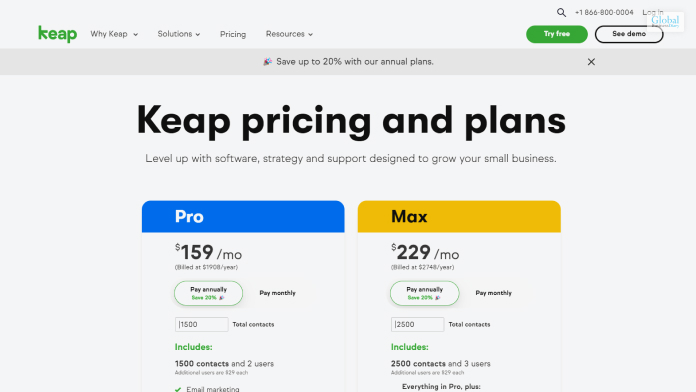
One of the best things that we have seen about Keap is that it has contact-based pricing. There are three different pricing levels of Keap. These are explained below:
| Plans | Pricing |
|---|---|
| Pro | $159 per month (annual billing) for 1500 contacts |
| Max | $229 per month (annual billing) for 2500 contacts |
| Max Classic | Custom pricing (for the need related to advanced marketing and sales) |
Apart from these, you will also get a free trial for 14 days, where you can try out the software and check the major features that are useful for your business. This will help you to get a better idea of what the software system is all about and how it can help your business.
What Are The Major Features Of Keap?

According to the claims of Keap on its official website, you can:
“Capture leads automatically with customizable forms that you can embed on your website and our custom landing pages. Use targeted and personalized email nurtures with automated triggers for more effective results.”
The following are some of the major features of Keap:
- Infusionsoft Email Marketing
- Easy automation of repetitive tasks
- Scoring leads to the prioritization of opportunities
- Built-in invoicing and payment processes
- Easy integration with many popular software applications
- Really efficient and featured contact management
- Automated marketing campaigns
Why Keap Is A Good Solution For Your Business?
As per the reviews on DreamGrow.com,
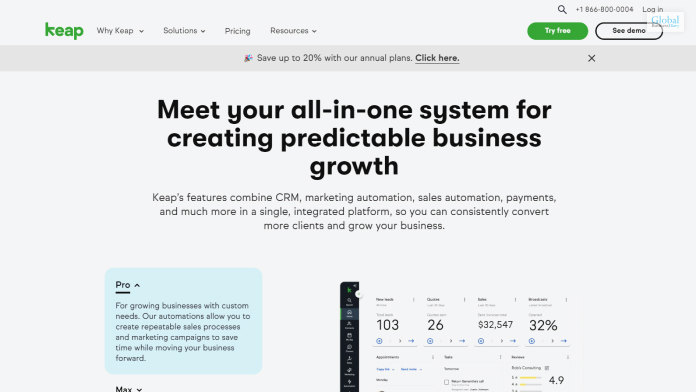
“Keaps’s sales and marketing automations make it so you don’t have to manually follow up with every lead, keep track of everything in docs, copy paste emails, or play the guessing game. It’s all done for you and grows your business 24/7 while you focus on other things.”
This software can be a great option for you if you are looking for marketing automation. Furthermore, Keap also offers you a lot of integration options that can help you enhance your productivity better. The all-in-one software can help you a lot if you deal with a variety of stuff, as happens in eCommerce businesses.
Keap (Infusionsoft) Pros And Cons

The following are the major pros and cons of Keap that you need to go through so that you get a better idea of what to expect when you make a purchase:
Pros Of Keap (Infusionsoft):
Here are major pros of Keap that are sure to benefit your business:
- It comes with both sales and marketing automation features.
- You will get access to the customer success manager on every pricing level. Furthermore, with the help of the Keap app, you can chat 24×7. There is phone support available as well.
- The collection and scoring of leads are automatic, which, in turn, helps in ensuring an efficient sales process.
- Easy segmentation of customers.
- It lets you combine CRM with email marketing processes.
- You will get to customize your dashboards as per your needs. There are autoresponders present in the software as well.
Cons Of Keap (Infusionsoft):
Here are a few cons of Keap that you need to be aware of so that you know what to expect out of the software platform:
- Often, integration with another software will require a monthly fee.
- The data migration process, which is available for free, is limited to your contacts, ten items, and one landing page.
- The pricing is based on the contacts. This means that the base pricing that you pay monthly grows with your contact.
- Some of the reporting features need updates
- A limited number of templates
- Limited search options for the user.
Major Alternatives Of Keap (Infusionsoft)

The following are the top alternatives of Keap that you can find easily:
2. Constant CRM
3. HubSpot Sales Hub
4. Active Campaign
5. Zoho CRM
Wrapping Up
Hope this article was helpful for you in getting a better idea of Infusionsoft by Keap. You can see that this software is quite useful for startups and small businesses. If your business is eCommerce, and you are searching for an all-in-one solution, then Keap is a great option for you to choose for your daily business processes. Although there are some good alternatives for Keap, when it comes to integration with other software systems, it is really good. What are your own reviews regarding this software platform? Share your thoughts with us in the comments section below.
Read More:
Tags:

Recent
Memory Chips Are Becoming More Important in the AI Era
Aug 06, 2026

Why Enterprise Web Applications Still Choose Angular for Long-Term Growth
Aug 04, 2026

Due Diligence Decoded: Why Careful Evaluation Still Wins in Business
Jul 11, 2026

How Hydraulic System Design Impacts Equipment Performance
Jul 01, 2026

Related Articles

Product Rendering Agency VS. Traditional Photography: Which Is Right For Your Business
This article answers this question: "What is the best method to capture consumer attention and drive sales – traditional photography or leveraging 3D product visualization services?" Keep reading to discover a suitable response to the question. Businesses continue to face the critical decision of whether to stick with the time-tested tradition of traditional photography or adopt the digital revolution through collaboration with a 3D product rendering agency. Find below the advantages, limitations, and major considerations surrounding these two methods to help businesses make an informed choice. Also, check out here why product 3Drendering services are necessary today. The Classic Approach Traditional photography has always been the bedrock of product presentation for decades. Its advantages lie in the realistic portrayal of products, providing consumers with tangible images that reflect what they can expect. The tactile experience of traditional photography and its widespread use makes it a familiar and comfortable choice for many businesses. However, traditional photography comes with limitations. The process is often time-consuming and resource-intensive, requiring the coordination of various elements such as lighting, props, and models. Post-processing can be challenging, with limited flexibility for experimentation and modification after the shoot. These factors contribute to higher costs and longer production times, which may not align with the pace and demands of today's market. The Digital Revolution By 3D Product Rendering Agency On the flip, product 3D rendering services present a digital leap forward in visual content creation. For instance, product rendering helps create lifelike visuals with virtually unlimited creative possibilities by using 3D modeling and computer-generated imagery. The digital world provides flexibility and efficiency, enabling businesses to experiment with designs, settings, and perspectives without physical limitations. The cost-effectiveness of partnering with a product rendering company, particularly in the long run, is a significant advantage. While there may be an initial learning curve for businesses new to rendering, the investment in skilled 3D artists or rendering agencies can pay off by streamlining the production process and reducing costs associated with reshoots and edits. Important Factors in Decision Making Nature of the Products If your products feature intricate designs or require frequent customization, working with a 3D product rendering company offers a level of detail and flexibility that traditional photography may struggle to match. Budget Considerations While traditional photography may have lower upfront costs, businesses should weigh this against the potential long-term savings and increased efficiency offered by product 3D rendering services. Brand Identity and Target Audience Consider how each method aligns with your brand identity. Some products may benefit from the authenticity of traditional photography, while others may thrive on the creative possibilities offered by product rendering. Making the Decision: A Strategic Approach Checklist for Decision-Making Create a checklist of priorities, considering factors such as visual aesthetics, production speed, and overall cost-effectiveness. Consulting with Professionals Seek guidance from professionals in both traditional photography and product rendering. Their insights can help align your visual strategy with your business goals. Balancing Short-term Needs and Long-term Goals Understand that the choice between traditional photography and product rendering is not binary. Striking a balance based on your short-term needs and long-term goals can lead to a hybrid approach that combines the strengths of both methods. Adapting to Change Technological Advancements Keep an eye on advancements in both traditional photography and product 3D rendering services technologies, as breakthroughs can enhance the capabilities of each method. Consumer Preferences Monitor shifts in consumer preferences regarding visual content. Stay adaptable to changing trends to maintain relevance in the market. Integration of Methods Explore the potential integration of both traditional photography and product rendering to achieve optimal results. This hybrid approach may offer the best of both worlds, combining authenticity with creative flexibility. Wrap Up Choosing between a 3D product rendering agency and traditional photography is not a one-size-fits-all decision. It requires a thoughtful analysis of your products, brand identity, budget considerations, and future goals. Thus, your business can navigate the visual landscape strategically by understanding the advantages and limitations of each method, ensuring your chosen approach aligns seamlessly with their unique needs and aspirations. Whether rooted in tradition or adopting product 3D rendering services, it is vital to make informed decisions that propel your business forward in the visual landscape. Read Also: Tips For Beautiful Maternity Photos NIRA Instant Personal Loans: Are They Really Instant? The Art Of The Deal How: Photo Books Elevate Business Meetings
Nov 22, 2023

A Comprehensive Guide To AI in Contract Management
Legal departments and firms worldwide are increasingly embracing Artificial Intelligence (AI) into their operations. This is despite fears from some lawyers as to the potential impacts. However, the evolution of AI into the legal profession should be welcomed because it will never replace the value of judgment-forming human lawyers. This stems from the fact that intelligence is a vital component of humanity, and AI extends on that quality. AI should be embraced as a value-building element that will facilitate the duties of lawyers and provide them with ample time to focus on more complex and demanding tasks. One notable area where AI is impacting the legal profession is contract management. Understanding The Aspect Of AI Artificial intelligence is also identified as cognitive computing. It identifies machine operations that copy human brain processes through making decisions based on some sets of data. AI programs operate through computer programs training and continuously trying through trial and error in unsupervised learning. Computers also learn from humans through supervised learning. An effective AI program can perform tasks that usually require human intelligence (Rich, 2018). For instance, these programs can translate languages and even recognize speech and objects. Artificial Intelligence In Contract Management Lawyers are increasingly using AI contract management software to classify contracts just in the same manner that some individuals are training AI programs to translate languages. On this note, lawyers are infusing AI programs with training sets that may comprise of different purchaser and supplier contracts. Upon the identification of the contracts, the AI program collects data from the training set in the classification of future contracts. In this regard, the program analyzes and examines the language that is commonly used in purchaser-friendly and supplier-friendly contracts. It is also possible for a lawyer to train the AI program to reject or request variations on specific language in the different types of contracts (Linarelli, 2021). It is worth mentioning that AI programs differ from the contract management systems used previously in legal departments in the storage and organization of file sets (Agarwal, 2020). This is because cognitive computing programs fully understand the completion of certain tasks conventionally assigned to lawyers. For example, these programs can establish patterns with a set of data, perform a comprehensive examination and provide the results. AI programs assist lawyers in identifying risks, future financial obligations, renewal and expiration dates, and anomalies. Lawyers are training AI programs on the actions required for specific contracts. For example, they are ensuring these programs send all non-disclosure agreements for review by the general counsel. Similarly, an AI program will have NDA contracts that meet the required threshold approved and executed. AI programs are also being used to remind lawyers of contracts that require to be renewed before the expiry dates. AI programs are also being established in ways that they can identify missing clauses in contracts. It is essential to note that AI programs in the legal industry cannot advise clients, negotiate deals, write briefs, and appear in court. Impacts of AI In Contract Management AI is a whole new frontier to master. Studies show that AI can have a huge impact on business verticals. This section will study how AI will impact business verticals and contract management in upcoming years. Increased Efficiencies Conventional contract management is rather labor-intensive, time-consuming and often inefficient. This is particularly because the drafting of contact is quite lengthy. Lawyers must read thoroughly through their drafts and ensure that they have all areas of different parties covered. There are delays, particularly when more people are involved in the creation or approval of the contracts. Based on the above facts, conventional contract management makes it utterly impossible and difficult for a lawyer to get a general grasp of all contracts. Lawyers in these departments handle large volumes of contracts. As such, it is often a struggle to extract requisite data into organized databases. Furthermore, contracts in many legal departments are often scattered in different email inboxes and hard drives instead of being situated in one database (Rich, 2018). This, in turn, fuels disorganization that causes missed deadlines and costly errors. It is worth mentioning that contracts make up a large percentage of financial transactions in entities. They also form the foundation and relationship between buyers and suppliers. As such, ineffective contract management can be quite catastrophic in terms of loss of capital. Studies have shown that companies lose about 9% of their annual revenues because of poor contract management costs. It is, therefore, strongly recommended for legal departments to digitize their contracts into AI programs. This initiative will save not only time but also money (Rich, 2018). AI programs will assist legal departments in using algorithms to make decisions and organize information. Lawyers can also infuse AI programs with sets of training data on non-disclosure agreements. These programs can then be used to identify the specific language in the NDA contracts. As such, contracts that meet the stipulated requirements for NDAs are approved and submitted for execution. It is also possible for AI programs to be trained to recognize agreements being reviewed and offer suggestions in terms of relevant provisions. For example, in the scenario the department frequently engages with a particular supplier, the AI program will be able to offer recommendations that have been utilized previously. Greater Risk Intelligence Contracts are quite sensitive and risky. In this regard, lawyers have conventionally been forced to monitor contracts throughout their enforcement period. With AI programs, lawyers are easily notified of deadlines. This frees them to tackle other meaningful and demanding tasks. For example, lawyers through AI programs establish rules for deadline reminders. One may choose to “find all contracts with certain expiry dates and choose to be notified one month or two weeks before”. This initiative is undoubtedly time-saving and provides lawyers with time to mitigate risks associated with each contract. It is also essential to note that forecasting is an attribute that all lawyers should strive to possess. For instance, an attorney may choose to determine whether litigation against a certain supply will be victorious. Experienced lawyers tend to have better forecasting attributes. Nonetheless, AI programs are much better and more accurate in the analysis of large sets of data. Through accurate predictions of potential contract litigation outcomes, lawyers will save entities significant amounts of money (Linarelli, 2021). Greater Accuracy and Consistency Undoubtedly, human beings are prone to errors. As such, relying on them to accurately review and draft contracts is ill-advised. As is the norm, individuals often copy and paste from templates when creating contract drafts. In this regard, they often or are bound to omit certain sections. Despite them spending countless hours going through the documents to ensure all aspects are covered and flagging problematic clauses. It is based on the above facts that AI programs are highly recommended. They will reduce the costs and mistakes that are brought about by human error. There are some AI programs that prompt lawyers to choose specific clauses that they will accept or reject. As such, if a contract is uploaded but misses some important clauses, it is immediately rejected. AI programs will also foster consistency in contract management. For instance, these programs can ensure that particular definitions are used across all contracts in the department or pertaining to a certain supplier. AI programs also allow for the extraction of key data from contracts (Linarelli, 2021). In so doing, they provide an overview of fundamental concepts in the contracts. Some AI Contract Management Tools You Need To Know About Currently, the market is saturated with AI Contract Management tools. However, you need to have a clear idea about what you want and need. This section is meant to educate you on some of the best AI Tools you can use for contract management. Docusign CLM Docusign CLM is the first AI Contract Management Tool that we would like to discuss. The tool is popularly lauded as one of the best AI-powered management tools in business. The tool is ideal for technical as well as non-technical users. This tool is best suited to manage small to medium-tier businesses. This application is known to process complex approval processes and mediate between clients and stakeholders. However, the application has a very modern user interface. This can be a little challenging for people with limited technological clarity. The pricing for this software ranges from £8 /month to £33 /month. Icertis The next AI-based contract management tool that we would like to talk about includes Icertis. Icertis converts contracts into strategies and strategic assets. This can help with compliance and other similar issues altogether. As a result, the application can streamline the contractual process and enable better decision-making. Icertis uses AI tools in order to create individual or mass-contracts. The platform also offers services like contract negotiation, risk assessment, and many more. Icertis works best in an AI-powered ecosystem. Therefore, you will not face any challenges while integrating this tool with other tools you have. One of the biggest cons of this tool is that the customer support team has a long response time. This can be challenging and can disrupt operational flow. As of now, the pricing for this tool is unavailable. Contract Works The third AI-based contract management tool on this list is Contract Works. This AI-powered tool is one of the best tools for managing business contracts and contract preparation. The tool helps in automating basic and mundane tasks. As a result, a lot of your time will be saved. This tool works in synergy with the ChatGPT architecture. Therefore, the application will enable you to do several tasks at one time, from preparing redline contracts automated email replies, etc. This is a great tool to have in your arsenal. However, the tool does not support integration with ERP or CRM tools. As a result, the tool can get a little restrictive in some sense. The pricing of the tool starts at around $700 per month and can go up to $2000 per month. Conclusion With that, you have reached the very end of our article about the role of AI in contract management. Before you start gravitating towards AI for contract management, just remember that AI is a new frontier. As a result, expect to see some major shifts in the design. You May Also Like.. The Role Of Responsive Design In B2B Websites The Importance Of Tech Support For Your Small Business The Art Of Automation: Streamlining Marketing Processes With Tech
Feb 22, 2024

The Evolution Of IT: Understanding The Role Of Managed Support In London
The landscape of Information Technology (IT) has been one of relentless innovation and transformation. In London, a city renowned for its blend of historical significance and modern dynamism, this evolution has been particularly fascinating. The journey from the days of room-sized computers to today’s cloud-driven, AI-enhanced systems tells a story of not just technological advancement, but of a city’s adaptation and growth in the digital age. In the early years, IT was a niche field, the preserve of experts and large organizations with the resources to invest in these emerging technologies. This era was marked by a focus on hardware and basic software, laying the foundation for the digital revolution that would follow. As London's businesses and institutions began to embrace these new tools, the city started to establish itself as a hub for technological innovation. The move towards personal computing in the latter part of the 20th century marked a significant shift. Technology became more accessible, and with this accessibility came a new set of challenges and opportunities. London, with its diverse and dynamic business landscape, was at the forefront of adopting these changes, driving innovation in various sectors, from finance to creative industries. The Early Days of IT in London London’s journey in the IT realm began much like the rest of the world, with large, cumbersome computers that required extensive expertise and resources to operate. Initially, IT was the realm of large corporations and academic institutions, with limited access and understanding among the broader public. The Rise of Personal Computing and the Internet The 1980s and 1990s marked a significant shift with the advent of personal computing and the Internet. Suddenly, computers were not just tools for big businesses; they became accessible to smaller businesses and even individuals. This democratization of technology brought a new set of challenges, particularly in terms of support and maintenance. The 2000s: A New Millennium of IT Challenges As the new millennium dawned, IT faced a myriad of challenges, from the Y2K bug to the increasing complexity of systems. This period saw the rise of new technologies like cloud computing and big data, necessitating specialized skills for effective management and support. Managed IT Support: A Response to Growing Complexity It was during this era that the concept of managed IT support in London gained prominence. Businesses realized that managing IT in-house was not only costly but also detracted from their core activities. Managed IT support offered a solution – outsourcing the management of IT infrastructure to specialized providers who could offer expertise, efficiency, and cost-effectiveness. The Role of Managed IT Support in Modern Business Today, managed IT support is an integral part of the business landscape in London. Providers offer a range of services, from routine maintenance and monitoring to strategic planning and cyber security. One of the critical aspects they manage is password security, ensuring that businesses’ data remains secure against the ever-present threat of cyberattacks. Password Security: A Crucial Element Password security has become increasingly vital in the digital age. With the proliferation of online services, ensuring that passwords are robust and secure is a crucial defense against data breaches and cyber threats. Managed IT support providers play a crucial role in implementing and maintaining stringent password policies and security measures for businesses. The Impact of Cloud Computing and AI The advent of cloud computing and artificial intelligence (AI) has further revolutionized the IT landscape. Managed IT support providers in London have had to adapt to these new technologies, offering cloud management services and AI-driven solutions to their clients. Managed IT Support and SMEs Small and medium-sized enterprises (SMEs) have particularly benefited from managed IT support. With limited resources and expertise, these businesses can access high-level IT support that was previously only available to larger corporations. The Future of IT and Managed Support As we look to the future, the role of managed IT support is set to become even more crucial. With the ongoing digital transformation, the rise of remote working, and the continual emergence of new technologies, businesses will increasingly rely on managed IT support providers to navigate these changes. Conclusions As we look to the future, the trajectory of IT's evolution in London is set to continue its upward and outward expansion. The city stands on the brink of a new era of technological advancement, marked by developments in fields like quantum computing, blockchain, and the Internet of Things (IoT). In this context, the role of managed IT support will be more pivotal than ever. These providers will not only continue to offer essential support and maintenance services but will also act as navigators, helping businesses to understand and integrate these emerging technologies into their operations. Furthermore, the ongoing global challenges, such as the pandemic-induced shift to remote work and the growing concern around cybersecurity, have highlighted the critical role of robust and adaptable IT infrastructures. Managed IT support services in London are evolving in response to these challenges, offering more flexible, secure, and innovative solutions to meet the diverse needs of businesses in a post-pandemic world. As we consider the future of IT in London, it is clear that the city’s position as a global tech hub will be bolstered by the strength and adaptability of its IT support infrastructure. Managed IT support will not just be a facilitator but a driver of innovation, enabling businesses to harness the full potential of technological advancements while ensuring security, efficiency, and competitiveness in a rapidly changing world. In conclusion, the journey of IT in London is a microcosm of the global evolution of technology. From its early days to its current status as a cornerstone of business and society, IT has transformed how we live, work, and interact. Managed IT support services have played a crucial role in this transformation, and as we move forward, they will continue to be key players in shaping London's digital future. Read Also: Top Florida-Based Software For Audit Management Equity Theory: A Balancing Act For Modern Workplaces Unleashing The Power Of Azure Integrated Services For Enhanced Cloud Capabilities
Dec 14, 2023
The AI Revolution: How Industries Are Driving Innovation?
It feels like we blinked and suddenly AI is no longer a mere hype. Now, it is stitched into the way businesses breathe and move. What was once sci-fi chatter now sits in boardrooms. In fact, it shapes decisions, nudges customer interactions, and quietly rewrites the rules of competition. Companies do not merely want efficiency. Rather, they look for fewer errors, more speed, and better precision. Hence, either you adopt or risk falling behind. This urgency is reshaping entire industries faster than most leaders expected. Healthcare Shifts Whether it is hospitals, clinics, or even small practices, algorithms are everywhere. This enables early detection and more accurate diagnoses. Also, doctors rely on data sets so massive they would drown without AI sorting through them. Moreover, those insights help generate treatment plans that feel tailored rather than generic. As a result, patient flow becomes smoother. Also, administrative burdens become lighter and surgical precision gets better through tools that do not tire or lose focus. Read also: How AI Is Quietly Reshaping Pharmaceutical Manufacturing Retail in Motion Shopping is no longer just shopping, but is quite predictive and curated. Retailers use AI to guess what shelves should hold before customers even walk in, and online recommendations pop up as they know you better than you know yourself. Inventory shortages shrink, trends are mapped in real time, and customers expect it now. Moreover, retail leaders keep investing, and the bar keeps rising, reshaping what “good service” even means. Predict inventory shifts before they happen Suggest products based on browsing behavior Reduce wasted stock and missed sales Map demand patterns with greater accuracy Finance Under Watch Money moves fast, risk moves faster, and AI steps in to keep pace. AI also helps to scan transactions in real time. Also, if there are suspicious blips, they are easier to flag before damage spreads. Moreover, advisors rely on AI-generated insights. These include the following: Market patterns Portfolio tweaks Risk assessments. As a result, confidence grows because decisions feel less like guesswork. This way, firms operate quickly, steadily, and with stronger security. Education Rewired Classrooms no longer look the same. This is because adaptive platforms adjust lessons midstream, nudging students forward at their own pace, while teachers breathe easier with grading automated, freeing time for actual teaching. Planning the Path Of course, implementation takes thought, patience, and structure. Moreover, generative AI training matters. Also, data protection is not optional, and departments must collaborate. Hence, it is best to start small and expand slowly. In fact, organizations that pace themselves find adoption smoother, less disruptive, and more sustainable. Key Considerations Invest in generative AI training for teams Build strong data protection frameworks Encourage cross-department collaboration Choose scalable tools that grow with the organization Pilot projects before full-scale rollouts Think of the Bigger Picture! This is not just about tech adoption. Rather, it is about how organizations define innovation itself. In fact, AI is not a shortcut, but a shift in mindset. So, companies that step in with intention will ride the wave instead of being swept up by it. No matter what sector you are in, the future tilts toward those who blend smart tools with thoughtful execution. The story of AI is no longer about possibility. Rather, it is about inevitability. Moreover, the organizations that embrace it with care and clarity will set the pace for others. Read Also: AI for finance and Financial Markets: Let’s Explore A Comprehensive Guide To AI in Contract Management
Nov 20, 2025