





What Is Insightly? Best Features, Pricing, Pros, Cons, And Alternatives

Insightly CRM is a useful software system for real estate, sales operations, and startups. This CRM and lead management software is based on the cloud and can help your business to improve its flow and organization. This software comes with a collection of helpful and effective marketing tools. If you are looking for marketing automation and better lead management, go for Insightly.
In this article, you will get a general review of Insightly, as well as the plans and pricing options of the software system. Furthermore, we will also discuss all the major features of the software and then help you determine whether this software system is helpful for your business or not. Finally, we will also share with you the major pros and cons of Insightly.
Insightly – A General Review Of The CRM
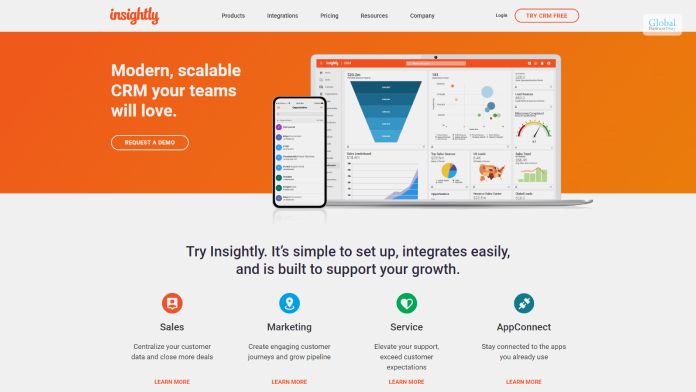
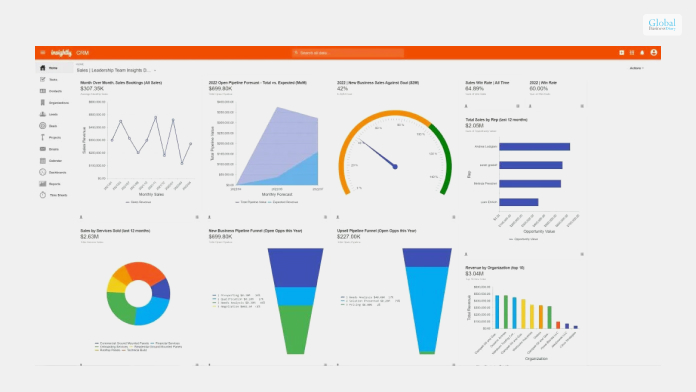
Insightly is a CRM that is based on the cloud and also consists of a pipeline management tool, which can make it easy for your teams to collaborate and work with each other better. You will also get reports and analytics on simple, easy-to-read, and brightly colored charts.
Furthermore, you also have the option to customize your dashboard as per your needs and demands so that you can have better access to data. This can help you gain a better and quicker understanding. If you want a reliable project management tool within your CRM software, then Insightly can be a great option for you.
As a review on Fool.com rightly puts it –
“Insightly is a CRM software for small and medium business owners who want to improve the way they manage leads, projects, and sales. If this is an area where your business struggles, then Insightly offers value and convenience.”
This software platform allows you to integrate your sales automation processes with project management. You will get a variety of tools for a variety of work in your business. The software platform is a good option for small and medium-sized businesses that are looking for a CRM where they can track their leads better and carry out opportunity management effectively.
Insightly Pricing And Plans

With Insightly, according to Forbes Advisor,
“Depending on which plan you choose, you can streamline a variety of pipelines, tasks and workflows, whether for sales and marketing teams or for general project management.”
The following are the plans of Insightly:
| Plans | Monthly Pricing | Yearly Pricing | Maximum Users |
|---|---|---|---|
| Free | $0 | $0 | 2 |
| Plus | $35 per user per month | $29 per user per month | Unlimited |
| Professional | $59 per user per month | $49 per user per month | Unlimited |
| Enterprise | $129 per user per month | $99 per user per month | Unlimited |
In addition to that, if you are an interested user, you can also check out a 14-day free trial, which can get you a good idea of what the software system consists of.
What Are The Major Features Of Insightly?
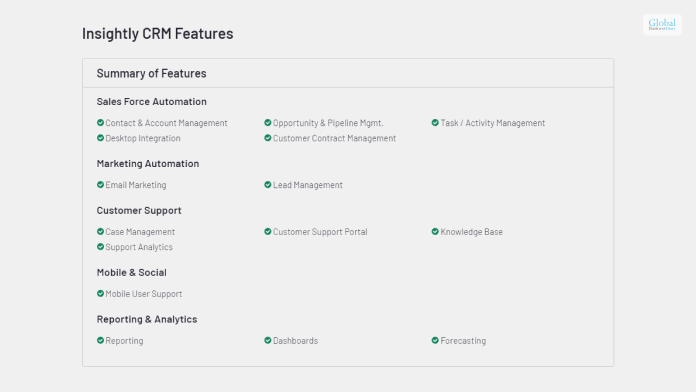
This is what FitSmallBusiness.com says about the features of Insightly,
“This platform helps you manage sales opportunities more efficiently by providing a system for tracking all the pipeline stages and custom fields under each deal.”
The following are the major features of Insightly that you must understand:
- Top-end contact and organization management
- Ease of usage and easy customization of the software.
- Bright, highly customizable, and catchy Insightly analytics and reports.
- Better lead management, opportunity management, assignment, and routing.
- Many email templates with mass emailing features.
- Automation of workflow on any type of project
- Ability to integrate with third-party software systems.
Can Insightly CRM Be A Good Addition To Your Business?
There are a few things that set Insightly apart. According to a review by Forbes Advisor,
“The project runway really sets Insightly apart from other CRMs. This tool visually displays any project’s location on the runway. Users can create custom fields segmenting projects for completion so that there is a uniform way to guide anyone through a project.”
Such factors can make it easier for your business teams to work and coordinate better with each other. Here, a team can have a better idea of what the next step is and what course of action is needed for the completion of any project. Apart from that, it gives users get better access to what tasks they have in hand at the moment.
Insightly – What Are Its Pros And Cons?

Like every software system, Insightly also has its pros and cons that one must need to be aware of before buying. This is important for you as you can understand what to expect from this software system. Here are the top pros and cons:
Pros Of Insightly
The following are some of the major pros of Insightly that are likely to benefit your organization:
- After Insightly Login, you can easily carry out lead management and manage your projects and contacts. All these features are available on every plan.
- The mass emailing option is available with all the plans.
- You can customize your dashboard on the top two plans. The sales workflows are also highly customizable.
- Integrates amazingly with third-party software systems and applications.
- Easy automation of workflows, tasks, reports, emails, etc.
- The mobile app allows real-time synchronization of data.
- Contains excellent tools for project management purposes.
- There is a perpetual free plan for up to two users.
- Customer support is proactive and does a fantastic job of resolving any issue.
Cons Of Insightly
The following are a few cons of Insightly CRM, which you must know so that you can prepare yourself in that regard:
- The top-end marketing features are available only for the higher tier plans.
- Many people faced a break in integrations.
- Only the expensive plans contain the workflow automation feature.
- There is an additional fee for phone support.
- The report customization options are limited.
- Limited record and storage for the free plan.
- Call routing and a built-in dialer are only available as add-ons to the base plan.
Wrapping Up
As you can see, Insightly is a useful software system with a large number of features that can help you enhance your CRM, lead management, and sales processes. Furthermore, it can also help you to increase your productivity. What are your reviews of Insightly? Share your views in the comments section below.
Read Also:
Tags:

Recent
Dinmukhamet Idrisov and a Gold-Mine Dispute From Kazakhstan’s Oligarchic Past
Oct 16, 2026

Memory Chips Are Becoming More Important in the AI Era
Aug 06, 2026

Why Enterprise Web Applications Still Choose Angular for Long-Term Growth
Aug 04, 2026

Due Diligence Decoded: Why Careful Evaluation Still Wins in Business
Jul 11, 2026

Related Articles

Advanced Techniques In Reverse Address Lookup
Times change, and so do the means of how we interact with the world around us. The significance of reverse address lookup shines brighter than ever. It's not just about finding a place on a map; it's about unlocking a story behind each door. Whether it’s ensuring that a birthday gift arrives at the right doorstep or empowering businesses with savvy address owner lookup tools, these services are reinventing connections in a world that thrives on information. This introduction will whisk you through the intricate dance of technology and data that has elevated reverse address lookup to an art form crucial for intricate and beyond. Old School Doesn’t Work Anymore. Machine Learning Takes Over Machine learning (ML), the dazzling star in the artificial intelligence (AI) firmament, is revolutionizing the reverse address search game. North America, blazing the trail with a whopping 43% contribution to the AI market, is a testament to ML's pervasive impact. This technology refines free reverse address lookup services with an accuracy that was once a distant dream. By sifting through vast datasets, ML algorithms identify patterns and correlations that escape the human eye, continually learning and improving with each search. The projected global ML platform size, which will be standing at a staggering $31.36 billion by 2028, underscores the massive investment in this technology. It's not just about improving efficiency; it's about reshaping how address data is used and validated. Consider a case study where a leading delivery company implemented ML to enhance its reverse address search capabilities. The result was a dramatically reduced misdelivery and a robust verification system that could confidently weed out errors and ambiguities in address data. Similarly, reverse directory address lookup platforms are now employing ML to offer services that are not just cost-effective but also remarkably precise, ensuring that even the most common user has access to high-quality information at their fingertips. These advancements are a leap forward, bridging the gap between data and reliability, one search at a time. NLP Can Change The Whole Face Of The Industry Natural Language Processing (NLP) is set to revolutionize the industry of locating and identifying addresses. This advanced technology interprets the complexities of human speech, transforming the way we interact with databases and digital directories. Deciphering Freeform Data NLP shines in its ability to organize the disarray of unstructured information. For services that unearth addresses from a tangle of text, NLP algorithms meticulously extract and sort data into a meticulously structured format. Such advancement is invaluable for entities that manage extensive records where addresses are often not neatly listed. Refining Customer Engagement Reverse address lookup tools are becoming increasingly sophisticated, offering user-friendly dialogue systems that understand and respond to spoken or typed requests in everyday language. This advancement breaks down barriers, inviting a broader audience to engage with technology in a manner that feels natural and straightforward. Forward-Looking Analysis And Error Correction NLP is not only reactive but also predictive. It assesses patterns in data entry and user interaction, predicting and preempting user intentions. This foresight allows for immediate suggestions and on-the-fly rectification of mistakes in address input, streamlining the lookup service and enhancing its reliability. The integration of NLP into reverse address lookup systems isn't just an upgrade—it's a complete overhaul of the user experience, promising a future where information retrieval is seamless, interactive, and remarkably accurate. Geospatial Data Analysis IS A Thing Geospatial data analysis is like the heartbeat of modern navigation, isn't it? A raw, pulsing nerve center that maps out life, not just streets and points on a grid. It's visceral. We're talking about the very fabric of our journeys, our stories, our existence, maybe. When a rescue team pinpoints a lost hiker, that's geospatial data in action—beating against the odds, against the wild silence of nature. And it's not just about being lost and found. It's commerce, it's connection, it's that package from a loved one that finds its way across oceans and lands right at your doorstep. It's like a promise delivered. Final Words Reverse address lookup is not what it used to be before. Yes, it might have changed, but for good. And thanks to technology advancements, we’re yet to see the best of it…or the worst. Well, let’s hope for the first. Read Also: Samsung Electronics Flags 96% Drop In Q2 Profit As Chip Glut Drags On Why Apple Stock Is Doing Better Than Amazon, Meta, Other Tech Stocks? Microsoft Lays Off More Workers Beyond The 10,000 Employees Announced In Early 2023
Dec 08, 2023

Unlocking Affordable SEO: Boosting Your Online Presence On A Budget
The digital landscape is ever-evolving. It has been developing a staunch digital presence, which is significant for brands of all sizes. SEO or search engine optimization has an important role to play in this endeavor, but the cost can be a deterrent for those on a tight budget. However, there's good news: affordable SEO options exist that can help boost your online presence without breaking the bank. 1. Know Your Goals and Budget The first step in unlocking affordable SEO, with an emphasis on cheap SEO packages, is to have a clear understanding of your goals and budget. What do you aim to achieve with your online presence, and how much can you allocate to SEO efforts? Knowing this will help you tailor your approach and identify the most cost-effective strategies. Each SEO agency comes with its own set of services and prices offered. Hence, it is significant for you to look for a company that meets your SEO needs. Just because you need top-notch services, you don’t have to hire an expensive firm. There are plenty of affordable options available in the market as well. 2. Conduct Keyword Research Keyword research is the foundation of any successful SEO strategy. Fortunately, it doesn't have to be an expensive endeavor. There are free and affordable keyword research tools available that can help you identify relevant keywords for your business. Targeting the right keywords can significantly impact your online visibility. When you hire a company that has a dedicated in-house team, you do not have to worry about trivial issues. From researching the right set of keywords to making efforts and ranking your blog, they literally do everything to make ends meet. 3. Optimize On-Page SEO Optimizing website elements that can boost its ranking on search engines refers to on-page SEO practices. Further, it involves optimizing meta titles and descriptions, using header tags, and ensuring your content is high-quality and relevant. These optimizations can often be done in-house without significant expenses. A professional firm takes the help of search engines and finds relevant keywords. Then, they seek other on-page SEO elements and verify whether or not a page matches the search intent of the user. 4. Create High-Quality Content Content is king in the world of SEO. Creating valuable, informative, and engaging content can help you rank higher in search engine results pages (SERPs). If you have a limited budget, focus on creating a content calendar and producing regular blog posts or articles that provide value to your audience. While producing content for the website, make sure to focus on quality, not quantity. Be regular with the article publishing but also ensure to enrich them with quality. The key to winning the hearts of readers is to provide them with quality content. 5. Leverage Free SEO Tools The internet is teeming with free SEO tools that can aid your optimization efforts. From SEO audit tools to backlink checkers, these resources can help you identify areas for improvement and track your progress. Tools like Ahref and Answer the Public offer you great keyword research facilities, whereas SEM Rush and Yoast are more like SEO-writing assistants. While hiring an SEO agency, ask them about the type of tools they will be using to take your website to another level. 6. Opt for Local SEO If you're a local business, prioritize local SEO efforts. Claim and optimize your Google My Business listing, encourage customer reviews, and ensure your business information is consistent across online directories. Local SEO can significantly impact your visibility in local search results. When it comes to bringing in qualified traffic and boosting your reputation, nothing matches the competency of local SEO. It is a staunch marketing technique that reduces dependency on a high spend on advertisements. 7. Monitor and Adjust Affordable SEO is not a one-time effort but an ongoing process. Monitor your website's performance using free analytics tools like Google Analytics. Track your keyword rankings and traffic, and adjust your strategy based on the data you collect. You might be wrong if you think that your job is done right after hiring an SEO agency. There is a constant need to track the search engine optimization practices they take into account. Further, adjust and tailor them as per your requirements. 8. Consider DIY or Freelancers If your budget is extremely tight, you might explore the do-it-yourself (DIY) route for SEO or consider hiring freelancers. There are numerous online resources and courses that can help you learn the basics of SEO. Freelancers can provide specialized expertise at a fraction of the cost of hiring an agency. Sometimes, freelancers are better than agencies because they work single–handedly. You might try hiring them and assigning them just a few projects initially. If they excel in these projects, assign them the real task. 9. Prioritize Mobile Optimization The process of mobile optimization refers to adjusting the content on your site and ensuring that readers can access it even from mobile devices. At present, the world has already shifted to cell phones, which is why mobile optimization is necessary. Mobile optimization is crucial in today's mobile-first world. Ensure your website is mobile-friendly to provide a seamless experience for users on smartphones and tablets. Mobile responsiveness is also a factor in search engine rankings. 10. Build Quality Backlinks While backlink building can be a complex and costly endeavor, there are affordable ways to acquire quality backlinks. Focus on guest posting on reputable websites in your niche, participating in industry forums, and utilizing your existing network for link-building opportunities. Last but not least, developing quality backlinks can elevate the standard and quality of your content. Ask the agency to paste the link organically within the page context and ask them to insert a reputable referring domain. In conclusion Unlocking affordable SEO is not only possible but also a practical approach for businesses looking to boost their online presence on a budget. By setting clear goals, leveraging free and cost-effective tools, and prioritizing strategies that provide the most value, you can achieve significant improvements in your search engine rankings and overall online visibility without straining your finances. Remember, consistency and adaptability are key to success in the ever-changing world of SEO. Read Also: Digital PR: The Gamechanger Of The Marketing Landscape 6 Tips For Growing Your Small Business And Boosting Your Bottom Line 7 Business Opportunities That Can Change Your Life In 2021
Aug 30, 2023

How AI Is Quietly Reshaping Pharmaceutical Manufacturing
AI in pharma is quietly changing everything. It is doing so without any loud and flashy headlines. However, it is doing so steadily and meaningfully. Moreover, this industry is built on precision. Hence, there is no room for “close enough.” So when AI shows up and starts helping with aspects like ingredient variability, environmental shifts, and human error, people pay attention. Although AI is not replacing experts, they are backing them up. This way, it is making their decisions sharper and their workflows smoother. Smarter Workflow, Less Drama In general, old-school automation follows the script and doesn’t improvise. Meanwhile, AI is totally different since it learns, adjusts, and improves with time. Take predictive maintenance. Machines don’t just break, but they whisper first through data. AI hears it and makes tiny shifts in performance. Also, it catches those issues before things go sideways. Hence, there are no more “surprise” breakdowns or “why is this happening now?” moments. And it’s not just machines. In fact, AI tweaks production settings in real time. Thereby, efficiency goes up and waste goes down. This feels like magic, but it’s just math. Supply chains are having the same story. Also, AI forecasts demand swings, spots shortages before they hit, and helps juggle global logistics. Innovation vs. Regulation: The Tightrope Walk Since tech moves fast, regulations also change constantly with time. That is why pharma companies are stuck in the middle, trying to push boundaries without crossing lines. AI is helping here, too, with natural language processing. It analyzes dense regulatory docs easily. Also, automated tracking keeps tabs on everything from start to finish. Moreover, AI also simplifies traceability and compliance. Hence, less time buried in paperwork means more time to actually innovate. It’s Not About the Buzz. It’s About the People. This isn’t some shiny tech trend. Rather, it is about building systems that work better for the workers on the factory floor and the patients waiting for meds. Moreover, the big shift is quieter. It is happening in the background, in the data, and in the tiny decisions that add up. Hence, there are no fireworks but just progress. For additional insight into how AI is redefining standards in pharmaceutical production, explore the visual guide accompanying this article from Advanced Technology Services, provider of preventative maintenance services. Read Also: A Comprehensive Guide To AI in Contract Management
Oct 17, 2025

Why Do Brisbane Businesses Need Computer Repair Professionals?
In today's technology-driven world, computers have become the backbone of businesses in Brisbane. Businesses heavily rely on computer systems for their day-to-day activities, from managing operations and communications to storing critical data. However, when these systems encounter technical issues or malfunctions, they can significantly impact productivity and hinder business growth. That is why professional computer repairs in Brisbane are crucial. Brisbane, the capital of Queensland, is a vibrant and dynamic city known for its thriving business community and stunning natural landscapes. Situated along the banks of the Brisbane River, the city boasts a subtropical climate, making it an attractive destination for businesses and residents. In this article, you will explore why Brisbane businesses need computer repair professionals and how their expertise can ensure smooth operations and mitigate potential risks. Expertise And Technical Knowledge: Computer repair professionals in Brisbane possess the expertise and technical knowledge necessary to address a wide range of computer-related problems. With their extensive experience and training, they can quickly diagnose and troubleshoot issues, saving businesses valuable time and effort. Their in-depth understanding of hardware, software, and networking allows them to provide efficient solutions tailored to each business's unique needs. Timely Issue Resolution: Downtime due to computer issues can significantly impact business operations, resulting in lost productivity and revenue. Computer repair professionals in Brisbane offer timely issue resolution, ensuring businesses can get back up and running quickly. With their prompt response and efficient problem-solving skills, they minimize downtime and keep the business running smoothly. Preventive Maintenance: Computer repair professionals address existing issues and provide preventive maintenance services to Brisbane businesses. Regular maintenance, such as software updates, virus scans, and system optimization, can help identify potential problems before they escalate. By proactively monitoring and maintaining computer systems, professionals can prevent critical issues from occurring in the first place, saving businesses from costly downtime and data loss. Data Security And Recovery: Data security is a top priority for businesses, and computer repair professionals in Brisbane play a crucial role in ensuring the safety of sensitive information. They can implement robust security measures, including firewalls, encryption, and backup solutions, to protect against cyber threats and data breaches. In the event of data loss or system failure, professionals can also facilitate data recovery, minimising the impact on business continuity. Scalability And Upgrades: As businesses grow and evolve, their computer systems need to scale and adapt to changing requirements. Computer repair professionals in Brisbane can assist with system upgrades, hardware installations, and network expansions to support business growth. They can recommend cost-effective solutions and ensure compatibility and seamless integration, allowing businesses to leverage technology to its fullest potential. Cost-Effectiveness: While some businesses may attempt to handle computer repairs in-house, it is often costly and time-consuming. Investing in computer repair professionals in Brisbane offers a cost-effective solution. These professionals have the necessary tools, expertise, and resources to resolve issues efficiently, minimising the risk of further damage. Outsourcing computer repairs in Brisbane also allows businesses to focus on their core competencies and allocate resources effectively. Conclusion: In today's digital landscape, Brisbane businesses heavily rely on computer systems for their day-to-day operations. The expertise and services provided by computer repair professionals are essential in ensuring the smooth functioning of these systems. From timely issue resolution and preventive maintenance to data security and scalability, these professionals offer a range of benefits that businesses cannot afford to overlook. By investing in their services, Brisbane businesses can minimize downtime, optimize productivity, and stay ahead in a technology-driven world. Moreover, with its thriving business community and vibrant cultural scene, Brisbane provides an ideal environment for businesses to thrive and grow. Read Also: understanding how VPS hosting can help you grow your online business top 5 types of businesses that are giving more profits to the sellers 10 signs your boss is testing you | need to know about
Jul 11, 2023