





Creatio CRM – Review, Major Features, Pros & Cons, And More

Creatio CRM comes with advanced lead management tools for streamlining the sales and communication processes of your organization. Despite being a bit highly-priced, the software comes with a variety of automation features required for smooth processing. If you are looking to automate the workflows of your organization, then Creatio is a great option for you.
In this article, you will first get a general overview of Creatio CRM. Then, we will also discuss the pricing plans that Creatio offers. Then, you will learn the major features that Creatio offers for your business, from which you can benefit. And you shall learn whether Creatio is a good software for your business or not. Finally, we shall discuss the pros and cons of the software. Hence, to learn more about this CRM, read on through to the end of the article.
Creatio – A General Overview Of The Software
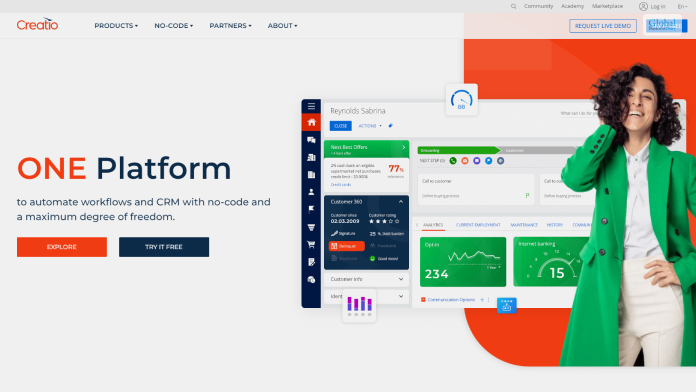
Once you do a Creatio Login, you will find the interface quite appealing. However, it is simple and does not contain a host of unnecessary features. However, you will find those automation features which can be beneficial to you for your marketing and sales processes.
According to TechRadar.com,
“Creatio CRM is a comprehensive sales and marketing software with plenty of tools to create campaigns and keep deals moving. The platform does a good job of categorizing leads to help streamline the sales process. However, Creatio CRM is somewhat complicated to use and getting access to all of the features can be very expensive.”
Creatio comes with three platforms – one for marketing, one for sales, and another for services. For processes relating to lead management and marketing campaigns, Creatio offers Marketing Creatio. On the other hand, Sales Creatio is for all the processes relating to sales, while Service Creatio is for streamlining customer service workflows of different levels of complexity.
Creatio Pricing And Plans
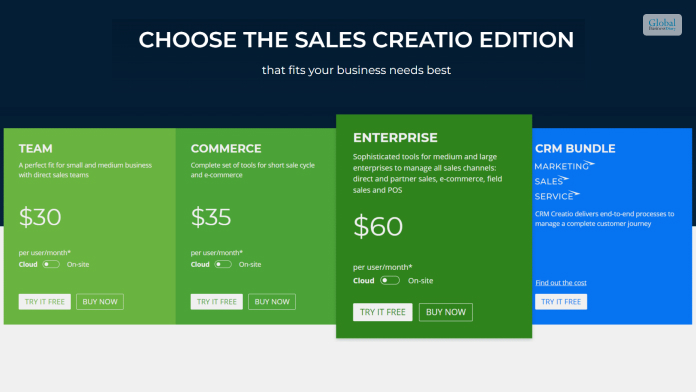
The following are the pricing and plans of the various Creatio platforms:
Sales Creatio
It is the primary CRM platform, where you will get a variety of tools related to deal management and follow-up. For every user, Sales Creatio costs $300 per year.
Marketing Creatio
This platform comes with tools for marketing that include email campaigns, lead generation, and event forums. The plans for marketing Creatio start at $875 per year (for one user). Here, you can deal with up to 1000 contacts and can make five emails to every contact per month. You will also get access to Creatio Marketplace.
Services Creatio
This one acts as your primary help desk software, where you can solve all the issues that your customers, leads, and inquirers are facing. For every user, Services Creatio costs $420 per year.
What Are The Major Features That Creatio Offers?
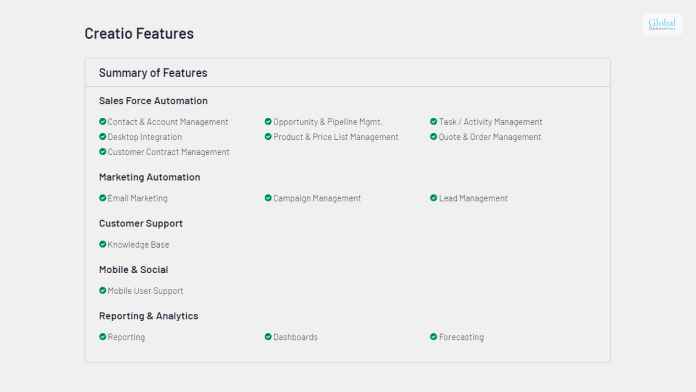
According to TechRadar.com,
“Creatio CRM has a very robust set of features, particularly if you have access to all three component software systems. Note that managers can get access to a special version of Creatio CRM that allows you to switch between Sales, Marketing, and Service from the platform dashboard.”
Since there are three different platforms of Creatio, hence it is better to look at them individually. Here are the features of all the Creatio platforms:
Sales Creatio
It offers easy categorization of leads. Furthermore, you will get workflow automation, plus notification. You can view and track your sales easily.
Marketing Creatio
The email marketing features are many, and you can set up online forms. However, there is no integration available with social media, which is a limitation.
Services Creatio
You can integrate with Sales Creatio and Marketing Creatio and use the essential tools to offer helpdesk services to your customers.
Can Creatio CRM Be A Good Option For Your Business?
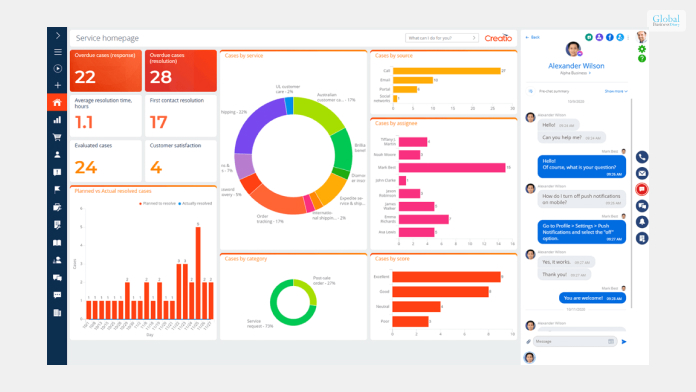
According to SoftwareAdvice.com,
“With Creatio, you can take advantage of a ready-to-go industry-leading CRM while also enabling users – whether business users without coding skills or professional developers – to create powerful business apps and easily automate various aspects of the company’s operations with no code.”
If you want to use Creatio for your business, you will get the following:
- A full view of your customers’ leads and opportunities.
- You can automate all the internal business processes of your organization.
- You can easily capture and track leads with the help of professional lead management tools.
The Essential Pros And Cons Of Creatio

Every lead management software comes with its own pros and cons. As a business administrator, you must have a good idea of whether the software you are using for your business is helpful for you and the organization. Here are the major pros and cons of Creatio:
Pros Of Creatio
As already discussed, Creatio comes with many features for lead management and client communication. Here are the major pros from which you will benefit:
- You will get automated reminders from the software as you try to follow up with new leads.
- You will get advanced email marketing tools to enhance your marketing processes.
- The dashboard is customizable and will allow you to design it as per the needs of your business.
- All the tools of marketing, sales, and services come in one platform.
- There are many different features and capabilities for quick implementation of processes.
- Easy collaboration with leads and customers.
Cons Of Creatio
Here are the few cons that we have found with Creatio CRM:
- If you want to get access to all the modules, it can get expensive.
- A limited number of integration options. No integration feature is available for social media.
- To create online forms, you will need to code in HTML.
Summing Up
Creatio CRM is a great option for you if you want individual software systems for your sales, marketing, and lead management processes. You can also offer help desk services to your customers with the help of Services Creatio. However, due to the lofty price, and lack of integration options with third-party software systems, we cannot recommend it fully for small businesses that need a lot of features in one place.
But if you need good automation features, you can certainly go for Creatio. What are your own reviews regarding Creatio? Share your views with us in the comments section below.
Read Also:
- Less Annoying CRM – Pricing, Features, Pros And Cons, And More
- Pardot – Best Features, Pricing, Pros, And Cons: Let’s Discuss
- Hatchbuck – Pricing, Features, Pros And Cons, And More
Tags:

Recent
Memory Chips Are Becoming More Important in the AI Era
Aug 06, 2026

Why Enterprise Web Applications Still Choose Angular for Long-Term Growth
Aug 04, 2026

Due Diligence Decoded: Why Careful Evaluation Still Wins in Business
Jul 11, 2026

How Hydraulic System Design Impacts Equipment Performance
Jul 01, 2026

Related Articles

Rippling Review: Features, Pricing, Pros & Cons, and Who Should Use It
Rippling is a cloud-based workforce management platform that combines HR, payroll, IT, identity management, benefits administration, and workflow automation into one system. It can be used for recruitment, onboarding, payroll, benefits management, offboarding, and many other processes. But will investing in this really be worthwhile? Short answer: yes, with a small caveat! For many growing businesses with global and distributed teams, it can be an excellent option, thanks to its: Automation capabilities Scalable platform Extensive integrations But its pricing policy and business-oriented options may turn out not to be exactly what businesses are looking for. In this review, we will talk about the key features of Ripple and try to understand if it’s perfect for you or not. Let’s begin What is Rippling? Rippling is a payroll software for managing employees that transforms the sometimes-difficult job of handling people operations into a smooth digital process with intuitive automation. With this tool, you can: Payroll processing and tax management Employee onboarding and offboarding Identity and access management Benefits administration Time and attendance tracking Workflow automation Employee device management App provisioning and user permissions Global workforce and contractor management One of Rippling’s standout features is its automation system. For example, when a new employee joins the company, businesses can automate multiple tasks through a single workflow, including: Creating the employee’s payroll profile Granting access to business applications Assigning company-issued devices Enrolling the employee in benefits programs Setting role-based permissions and security policies As these processes are done automatically on Rippling, this helps increase efficiency and reduce the chances of making a mistake. It can also deliver work equipment to new employees by ensuring they get what they need, such as Google Workspace and Microsoft Office 365. This makes it a nice choice for integrating remote, hybrid, or in-person employees. The Features of Rippling The tool combines various workforce management solutions in one package. It allows the companies to handle payroll, IT, HR, and other employee issues from one dashboard. Some of the features include: 1: Payroll Management Through Rippling, it becomes easier to automate payroll management through automatic calculation, automatic tax filing, and payment of employees. This software has been created to minimize different kinds of manual work too. Here are some of Rippling’s payroll capabilities: Automatic federal, local, and state tax filing Automated payroll processing Direct deposit and employee self-service Multi-state payroll support Global payroll for international employees 2: Employee Onboarding and Offboarding Rippling also helps with various onboarding and offboarding tasks through automation. Some of the features under this umbrella includes: Sending offer letters and onboarding documents Creating employee profiles and collecting electronic signatures Assigning company-provided devices, like laptops Enrolling employees in different benefit-related structures Provisioning email and software accounts Automation of these workflows ensures consistency in the onboarding process while enhancing the security of the exit process for employees. 3: HR Management Thanks to Rippling, you will also get a centralized HR system for managing the records of your employees. The tool can help with overviewing workforce operations and organizational structures as well. Some of these HR features include: Employee database and leave management Keeping digital personal records and organizational charts Storing employee documents Automating workflows for HR tasks Managing performance and policies of the organization 4: Benefits Administration Through rippling, the process of offering benefits becomes easier for companies as it enables them to handle health care, retirement and other forms of benefits using one single system. Companies will be able to: Enroll their employees into benefit plans Manage their health, dental, and vision coverage Administer retirement benefits Update benefits elections of their employees Automatically deduct benefits through payroll 5: Time and Attendance Tracking The tool comes with a special workforce management feature that helps businesses monitor employee working hours and attendance. Employee time tracking Attendance tracking PTO tracking and approval Overtime tracking Shifts scheduling (where available) Payroll integration Due to the direct integration of attendance data into payroll, there is little to no need for manual calculation of employee hours. 6: IT and Device Management Rippling is different from many other traditional HR softwares because it has the ability to manage IT. It helps businesses with: Managing company laptops and phones Applying security policies remotely Installing applications for business Setting up user permissions Monitoring device inventory Cleaning company data from lost and old devices This solution will be particularly useful for businesses that work with remote or hybrid teams. 7: App Provisioning and Identity Management The system automatically takes care of user access for many applications within the company, eliminating the need for any manual intervention and enhancing security. The features included in app provisioning and identity management are: User accounts created automatically Single Sign-On (SSO) Multi-Factor Authentication (MFA) Role-Based Access Control Permission Management Account Deactivation during Offboarding This enables companies to provide appropriate levels of access to employees. 8: Integrations Rippling has hundreds of integrations that will enable companies to link their HR, payroll, accounting, communication, and productivity applications. Some of the most common categories of integration include: Accounting application Customer relationship management application Communication application Productivity application Identity provider application Recruitment application Expense management application This enables teams to enter data manually and maintain information across different business applications. Advantages of Using Rippling Rippling is not simply an HR or payroll tool. The most important feature about the tool is its ability to merge HR, payroll, IT, and employee management in a single system. Companies will no longer need multiple systems to hire an employee, set up their laptops, and issue them a salary slip. All this can be done through one single dashboard. 1: It Eliminates Manual Work Automation is one of the best features of Rippling. There are many activities that require the involvement of HR, Payroll, and IT staff; these can all be performed automatically. For example, when a new employee joins the company, Rippling can: Generate an employee record Put them on the payroll Provide documentation for electronic signature Allocate software and email Sign up for employee benefits Establish role-based permissions Instead of completing these tasks one-by-one, your team can automate the process, save time, and reduce manual errors. 2: Everything Lives in One Place As your business grows, the information of your employees will often get scattered across different platforms. Payroll data may be stored in one system, IT access managed somewhere else, and HR records are in another place. Rippling solves this by centralizing workforce management. Both the HR team and payroll personnel use the same set of employee details, and, thus, can view everything from one place. 3: It’s Scalable The best thing about Rippling is that it is modular. You do not have to buy everything at once. As your organization grows, you can gradually buy new features to accommodate your needs. For example, if a small company starts off by using the payroll and HR functions but decides later on to include the following features: Benefits administration Time Tracking Device Management Identity & Access Management Global Payroll Expense Management Rippling: The Pricings Unlike many payroll and HR software providers, Rippling does not publish fixed pricing plans on its website. Instead, they use a custom, modular pricing model. So, the final cost of the product will depend on the size of your business and the integrations you are choosing. 1: How Does Rippling’s Pricing Work? Rippling’s pricing is based on five different factors - Number of employees in your company Products/modules that you choose Whether you need US payroll, international payroll, or contractor management Add-ons and integrations Support needs Since each company has unique requirements, you will have to ask for a customized quote from Rippling to get your exact cost. 2: Is Rippling Worth the Price? Rippling’s pricing may not be as transparent compared to its competitors which disclose fixed pricing packages, it could also work to their advantage especially if they cater to companies that require particular products only. The following firms may find Rippling's services worth it: Growing startup companies Medium-sized business organizations Remote or global companies Businesses requiring HR, Payroll and IT Management in a single platform In contrast, companies in search of an easy payroll system or desiring transparency in pricing may want to look elsewhere. Rippling Pros and Cons: At a Glance Like any other platform, Rippling has its pros and cons. Its biggest advantage is bringing HR, IT, payroll, etc into one place while the modular pricing can be an issue for many companies. ProsConsYou can automate offboarding and onboarding workflows and save your time.Pricing of the tool isn’t available publicly. So, contacting the sales team for a custom quote can be quite a hassle for some.Extensive integrations with productivity, accounting, and communication can make the users’ job much easier and dynamic.Some advanced features are only available as paid add-on modules.As it’s a modular platform, it allows businesses to add new features as they grow.The total expense can increase as you keep on adding new products and modules. The Bottom Line Our top choice is Rippling for … Companies seeking all-in-one HR software with a core focus on automation, capable of seamlessly integrating with their current business software, benefits, and apps. Midsize businesses looking to streamline their HR processes, from onboarding to offboarding and everything in between, in order to save time and maintain accuracy. Businesses seek the versatility of a highly customizable HR software platform with a wide range of reporting options. We advise against using Rippling for … Small businesses with low volume of repetitive HR tasks such as recruitment, orientation, resource distribution, benefits administration, and employee exits. Small and midsize businesses require extensive customer service assistance for managing and updating their operations-related tools and software. So, before you consider using Rippling, we’d ask you to evaluate your company as closely as possible. Also, talk to an expert and ask them if they think using the tool will do good for you. Read More: How Payouts Work: Exploring The Basics And Beyond How To Choose The Right Stocks: Tips For New Investors Coinbase: Essential Things To Know About This Fintech Company Should You Consider Insuring Your Employees: Reasons And Tips Top 10 Remote Work Management Tools For Your Business
Apr 03, 2024

Breaking Into Fintech: Skills For Fintech Essential for Aspiring Professionals
The Fintech industry has evolved at a faster pace over the last few years. Candidates are now aspiring to build their fintech careers in this field. Now, you may also be the one who is doing the same as well. In such a scenario, you need to know skills for Fintech that can help you to grow. A career in fintech can offer you a wealth of opportunities to steer your business in the right direction. It's a field that has piqued the interest of many job seekers. Particularly those with a passion for pursuing exciting roles in the Fintech Space. If you're considering a career in the Fintech Domain, it's essential to possess not only the right skills but also understand the market needs. This understanding will be instrumental in aligning your career goals with the industry's demands. Skills For Fintech Essential to Build Your Career in This Field There are certain skills for Fintech that you must know while building your career in this field. Some of the key skills that you should have to prosper and flourish in this domain are as follows: - 1. Technical Expertise Fintech is a highly tech-driven industry, so there is no doubt that your technical skills will be in high demand here. This includes the fact that you must have knowledge of certain programming languages to build your career here. Some of the key programming knowledge that you should have in this domain is Python, Java, and C++. You need to be completely familiar with API, cloud computing, and databases. Additionally, the knowledge of machine language will be of added advantage for you in this sector. Evolution Of Fintech is increasing the demand for this type of professionals. 2. Having Financial Knowledge Anyone working in Fintech should have a strong financial knowledge in the Fintech sector. This includes all the knowledge of things like payments, banking, risk management, and investing. Once you develop financial knowledge in this field, things will become easier for you. However, some companies hire chartered accountants and auditors to build a strong career in this field. You need to be well accustomed to it while meeting your career goals in this field. 3. Analytical Skills Fintech businesses generate a lot of data, so you need to be well-equipped with analytical skills. You need to identify the trends that can help you build your career in this field with complete ease. An individual must be well-versed with skills in statistics, machine learning, and data mining. Therefore, if you want to become a successful professional in Fintech industry. Then, you must sharpen your skills in these areas. 4. Problem Solving Skills The Fintech industry is evolving at a constant pace, so you need to think creatively and solve problems with ease. You need to develop your problem-solving skills to help your customers identify the best solution with innovative solutions. Global Fintech companies follow this pattern. Without the knowledge of appropriate problem-solving skills, you cannot sustain or flourish in this industry. Customers may have different types of financial issues and problems you need to hear them patiently and solve them aptly. 5. Communication Skills Strong communication and collaboration skills are vital for the Fintech industry. You must have the ability to communicate complex financial concepts to both technical and nontechnical audiences. Ensure that you possess strong communication skills. This can help your career move in the right direction, especially in the Fintech industry. It is one of the crucial skills for Fintech that you must be aware of. Fintech Careers Available In 2024 There are several types of Fintech careers available in 2024 that you must be aware of. Otherwise, things can become more complex for you in the long run. Without knowing the facts, things can turn worse for you. 1. Data Science & Analysis Transformation of the data is one of the crucial aspects of the Fintech business. A data scientist needs to have the requisite skills to analyze the data and make inferences to use it properly. Job Roles Of Data Scientist in Fintech Business Making critical decisions regarding invoices. Monitoring Data Transfer. Keeping track of buying and bookings. Making a Proper analysis of trades and subscriptions. Salary Scale of Data Scientist in Fintech Business As per Glassdoor data, a data scientist in the Fintech business earns between $118k and $200K/ year. 2. Quantitative Analyst To arrive at any financial conclusion, quantitive analysts have to make use of mathematical and statistical data. Fintech Business HR makes the recruitment of Quant experts. You need to be good at quantitative analysis to reach financial conclusions. Ant group also maintains this process of hiring. Job Eligibility Required for Quantitative Analyst In Fintech Business It is essential to have quantitive skills in statistics. You must have strong technical skills. Learn AI, machine learning, and programming skills. Salary Scale Of Quantitative Analyst In Fintech Business As per the data of Payscale, a Quantitative Analyst should a pay scale of $94,584 per year. 3. AI & ML Artificial Intelligence and Machine learning can become your industry while you seek the benefits from the data scientists. Many industries are now willing to work with machine learning professionals to perform the data mining process more easily than ever. Job Roles Of Machine Learning Expert in Fintech Business Making proper application of the AI tools. Using AI tools to grab the refined data from the market. Making accurate and fast decision-making. Salary Scale of a Machine Learning Expert In Fintech Business The salary scale of a Machine learning Expert in a Fintech Business is $97,476 per year. This is as per payscale data. 4. Governance Risk & Compliance GRC can make compliance in the process of Fintech business easier and more effective. You need to develop your skills in this segment as well. There are certain key responsibilities you need to shoulder in this sector. Some of them are as follows: - Job Responsibilities of GRC Officer in Fintech Business: - Monitoring compliance with the business using digital tools. Bringing Ci and ML in the picture. Application of Super-fast algorithms to handle any sea of transactions. Salary Scale of A GRC Officer In Fintech Business The salary scale of the GRC officer in the Fintech business is $125000 annually. You must be aware of it while attaining your requirements. Career Strategies You Can Adopt to Build Your Career in Fintech There are certain career strategies you can adopt to build your successful career in the Fintech business. You must be aware of it while reaching your requirements with complete ease. Some of the key factors that you should know here are as follows: - Explore subsectors like payment, Blockchain, Insurtech, and wealth management to build your skills in this area. Target the ideal companies who look for a strong market presence as well as innovation. Bridge up the knowledge gap by developing skills in Cybersecurity, data analysis, and Blockchain Fundamentals. Sharpen your financial literacy to build your business knowledge with complete ease. Ensure that you follow the right path to develop Fintech skills. Final Take Away Hence, if you want to grow your career in the Fintech Sector. You must be aware of the above-mentioned facts. Otherwise, things can turn worse for you in the long run. It would be better if you could share your feedback with us. Share your opinion and feedback with us in our comment box. This can boost your chances of getting more relevant information about this industry next time. For More Business Related Articles Click Below!! 5 Essential Aspects That Every Small Business Needs How To Choose The Right Stocks: Tips For New Investors How To Start A Concession Stand Business? – A Complete Guide
Mar 29, 2024

The Role Of Digital Agencies In Transforming Car Dealerships
Car dealerships, long identified by sprawling lots, vibrant banners, and the quintessential 'sales pitch', are undergoing a seismic shift, thanks to the rapid evolution of digital technology. As consumers' shopping habits gravitate more towards online platforms, the automotive industry finds itself at a crossroads, demanding a profound digital transition. Here’s where digital agencies specializing in automotive digital marketing solutions step in. They bridge the gap between traditional sales techniques and the demands of the digital consumer. So, let’s get started with this comprehensive guide, which explains the importance of digital marketing in car dealerships. It has a bunch of necessary insights for you, so keep reading. Digital Agency's Toolbox for Dealerships Whether you know it or not, most digital marketing agencies promote car dealerships among national and international clients. But which agency is the best for you? How do you discover that? Here are a few toolboxes that must be present at any digital firm for car dealerships: Building Robust Online Platforms: Gone are the days when a customer’s first interaction with a dealership was in-person. Today, a potential buyer starts their journey online. Digital agencies assist dealerships in creating user-friendly websites, offering detailed vehicle information, virtual showrooms, and even online purchasing gateways. Hence, the first thing you want to look at is the kind of platforms the agency is active on. There are millions out there that can and should be optimized for the best automotive deals. Why not make use of them? Creating robust online channels is the stepping stone for any digital firm. Data-Driven Personalization: Automotive digital marketing solutions revolve around leveraging data analytics. By understanding customer preferences, past behaviors, and browsing patterns, dealerships can offer tailored deals and promotions that resonate with individual consumers. Digital agencies utilize advanced Customer Relationship Management (CRM) systems to help dealerships craft these personalized marketing strategies. Fluff is something produced easily, but catching it is a big challenge. Therefore, search for companies that believe in data-driven personalization for your car dealership brand. Empowering the Shift to Electric: As dealerships expand their inventories to accommodate the rising demand for electric and hybrid vehicles, digital agencies play a pivotal role in marketing these vehicles to the eco-conscious buyer. They employ specialized campaigns highlighting the benefits of electric mobility, ensuring dealerships don’t just stock these vehicles but sell them effectively. Inspect what technological solutions the agency seeks. Do they use campaigns like PPC, SEO, and social media marketing to boost your car dealership strategy? If yes, then you can surely opt for them and, in fact, get more ideas on how to keep the process going. Elevating Customer Experience: Today’s consumer expects a seamless experience, both online and offline. Digital agencies help car dealerships integrate advanced tools, like video chat solutions, ensuring customers can engage with salespeople from the comfort of their homes. These tools not only offer convenience but help establish a trusted relationship between the buyer and the dealership. When the consumer experience is good, people will automatically want to be a part of your dealership plan. That’s how it works! Subscription & Mobility Solutions: Modern consumers are exploring alternatives to traditional car ownership. Recognizing this trend, digital agencies assist dealerships in setting up subscription or car-sharing platforms, appealing to a segment of the market that values flexibility over long-term commitment. If the digital company is already providing flexible solutions, there’s nothing to worry about. But what if they don’t? In such cases, make sure to communicate your needs well. When you partner alongside a different agency altogether, it is necessary to talk well and align both your plans strategically. Online Reputation Management: In an age where online reviews can make or break sales, maintaining a positive digital reputation is paramount. Digital agencies offer tools and strategies to help dealerships engage with customers, address concerns, and ensure a consistent flow of positive feedback. Use digital tools to maintain your car dealership brand’s online reputation. This can largely help you to reach an effective clientele and diminish the risks of potential damages. Strategic and Creative Thinking: One of the foremost things any digital agency should be well-equipped with is the ability to think creatively. There must be a plan of targeting clients in the best way possible because you don’t just want to target them but also convert them. Both creative and strategic thinking give a clear idea of opportunities and challenges the industry might be facing. Hence, opt for an agency that can think beyond the usual world and boost your car dealership business. Additionally, check out their portfolio and how they have managed clients in the past. Challenges and Solutions While the digital transformation journey promises immense opportunities, it's not devoid of challenges. Dealership staff, accustomed to traditional sales methods, might exhibit resistance to new digital tools. Digital agencies play a role in training and familiarizing these staff members, ensuring a smooth transition. Another significant concern is data security. With the escalating threats of cybercrimes, safeguarding customer data becomes imperative. Digital agencies equipped with expertise in cybersecurity can provide dealerships with solutions to protect sensitive information. Lastly, the financial and skill-based investment required for digital transformation can be daunting. However, with the right digital agency partnership, dealerships can optimize costs, leveraging the agency's expertise to deploy efficient automotive digital marketing solutions without the need to build in-house teams from scratch. Conclusion The car dealership landscape is undeniably changing, and the road ahead is digital. As dealerships navigate this new terrain, partnering with specialized digital agencies can offer them the tools, strategies, and expertise to not only adapt but thrive. In the age of online shopping, reviews, and instant gratification, it's these digital partnerships that will define the dealerships of the future. And it’s a wrap on this article. The car dealership is an emerging realm of the profession, and so is digital marketing. The amalgamation of both should have enormous benefits for you. Thank you for reading till the end. If you loved the article and have anything to share, comment below! Read Also: 6 Tips For Doing The Car Shipping To Georgia Process Right
Oct 31, 2023

The Role Of Responsive Design In B2B Websites
As companies strive to adapt to the dynamic digital landscape, the role of responsive design in B2B websites has emerged as a critical factor influencing user experience and overall success. Take a look as we explore the unique challenges and advantages of responsive design in the B2B context, providing insights backed by statistics and examples. The State of B2B Website Development Before delving into the specifics of responsive design, it's imperative to grasp the current state of B2B website development. Recent studies indicate that B2B e-commerce is on the rise, with projections estimating global B2B e-commerce sales to reach $20.9 trillion by 2027. This surge in online transactions underscores the importance of an effective digital presence for B2B enterprises. The Impact of Mobile Browsing in B2B While it's widely acknowledged that mobile browsing is a significant aspect of the consumer landscape, its impact on B2B interactions is often underestimated. According to a report by Google, 50% of B2B queries are made on smartphones, highlighting the crucial role that mobile devices play in business-related searches. This trend emphasizes the need for B2B websites to prioritize responsive design, ensuring seamless functionality and optimal user experience across a variety of devices. The Hidden Cost of Poor User Experience In the competitive realm of B2B transactions, user experience can make or break a deal. Surprisingly, a study by Forrester found that 70% of B2B buyers base their purchasing decisions on the supplier's website experience. A poorly designed or non-responsive website can lead to a significant loss of potential business opportunities. Investing in responsive design becomes not only a matter of technological adaptation but also a strategic move to capture and retain valuable B2B clientele. Responsive Design: Beyond Adaptability Responsive design goes beyond mere adaptability to different devices; it encompasses a holistic approach to enhancing user experience and achieving business objectives. If you’re considering this approach for your website, here are a few factors to consider. The Psychological Impact of Load Times In the fast-paced digital landscape, every second counts. A study conducted by Google found that as page load time increases from one second to five seconds, the probability of bounce increases by 90%. For B2B websites, where intricate product catalogs and detailed information are common, optimizing load times through responsive design is imperative. Efficiently designed responsive websites not only retain users but also contribute to positive perceptions of a brand's professionalism and reliability. Balancing Aesthetics with Functionality While aesthetics play a crucial role in user engagement, functionality is equally vital for B2B websites. Responsive design allows for a delicate balance between visually appealing interfaces and seamless functionality. The challenge lies in optimizing the user interface for clarity and simplicity while providing comprehensive information. Striking this balance ensures that B2B websites not only attract but also retain users, fostering a positive and productive online engagement. Leveraging Interactive Elements for Engagement Responsive design opens up avenues for incorporating interactive elements that enhance user engagement. B2B websites can benefit from features such as interactive product catalogs, configurators, and real-time collaboration tools. These elements not only provide a more immersive user experience but also contribute to increased time spent on the website, potentially translating into higher conversion rates and customer satisfaction. The Impact of Multi-Device Journeys on Conversion B2B buyers often engage with content across multiple devices before making a purchase decision. According to a study by Google, 49% of B2B researchers who use their mobile devices for research go on to make a purchase. Responsive design facilitates a seamless transition for users as they switch between devices during their research and decision-making process. A cohesive and responsive journey across devices can significantly impact conversion rates in the B2B space. Adapting to Emerging Technologies The landscape of web development is continually evolving, with emerging technologies shaping user expectations. Responsive design extends beyond compatibility with different screen sizes to encompass adaptability to emerging technologies. As voice search, augmented reality, and other innovations gain traction, B2B websites must be equipped to seamlessly integrate these technologies into the user experience. Responsive design acts as a foundation for future-proofing B2B websites against technological shifts. Prioritizing Accessibility for Diverse Audiences In the realm of B2B, catering to diverse audiences is essential. Consider the accessibility of your website through responsive design to accommodate users with disabilities. According to the World Health Organization, over one billion people globally have a disability, emphasizing the need for inclusive design. Implementing features such as alt text for images and ensuring compatibility with screen readers can enhance the user experience for all, fostering inclusivity and compliance with accessibility standards. Harnessing Data-Driven Personalization The responsive design opens avenues for data-driven personalization, tailoring the user experience based on individual preferences and behavior. Utilize analytics to understand user patterns, and implement responsive design elements that dynamically adapt content based on user interactions. This personalized approach can significantly enhance engagement and conversion rates by delivering content that aligns with each user's specific needs and interests. Integrating Social Proof and Trust Signals Building trust is paramount in B2B transactions. Responsive design allows for seamless integration of social proof elements, such as client testimonials, case studies, and trust badges. Strategically placing these trust signals throughout the website enhances credibility and instills confidence in potential clients. Responsive design ensures that these elements are displayed effectively across various devices, reinforcing trust regardless of how users access your site. Drive Greater B2B Websites Through Responsive Design B2B website design goes beyond conventional notions of adaptability. It is a strategic imperative that influences user experience, brand perception, and business outcomes. As these transactions increasingly migrate to the digital realm, responsive design emerges as a linchpin in the quest for a competitive edge. By understanding the impact of mobile browsing, recognizing the hidden costs of poor user experience, optimizing load times, balancing aesthetics with functionality, leveraging interactive elements, considering multi-device journeys, and adapting to emerging technologies, businesses can harness the full potential of responsive design to navigate the digital landscape successfully. As we move forward in the dynamic world of web development, responsive design remains a cornerstone for achieving sustained growth and relevance in the ever-evolving ecosystem. For further support, don’t hesitate to get in touch with a B2B website design agency. Read Also: Why Create A Powerful Business Continuity Plan? What Is Network Marketing And How To Do It In 2021 How To Start A Business In 2021 – Best Business Strategies
Feb 02, 2024